Veronika Günther’s artistic practice is deeply rooted in drawing. In her solo exhibition at The Tiger Room, she presents works that expand her drawing-based approach to include sculptural elements. It becomes clear that her practice, whilst appearing analogue, is unmistakably shaped by our increasingly digitalised world. Her drawings and sculptures act as an analogue mirror, reflecting, distorting and questioning the forces at work in the digital visual world.
Over time, Veronika Günther develops recurring motifs, which she intuitively collects, condenses and combines. This gives rise to associative visual spaces in which private and political images merge with artefacts from literature, film and other mass media. To this end, she naturally makes use of digital infrastructures such as smartphones, the cloud and online archives. Digital image archives, photographic source material and found objects, as well as a way of thinking in terms of layers, fragments and series, flow into her work without being explicitly addressed.
In recent years, she has developed and maintained a consistent and serial drawing practice. Working quickly, without preliminary sketches or corrections, she produces numerous small-format works at a rapid pace. What may at first glance appear to be a private system of notation turns out to be a structured archive. Over the years, this has given rise to a constantly growing repository of motifs that is neither hierarchical nor complete. Figures, animals, objects, text fragments and iconic images from pop culture, literature and art history circulate within it on an equal footing, forming a multi-layered visual memory.
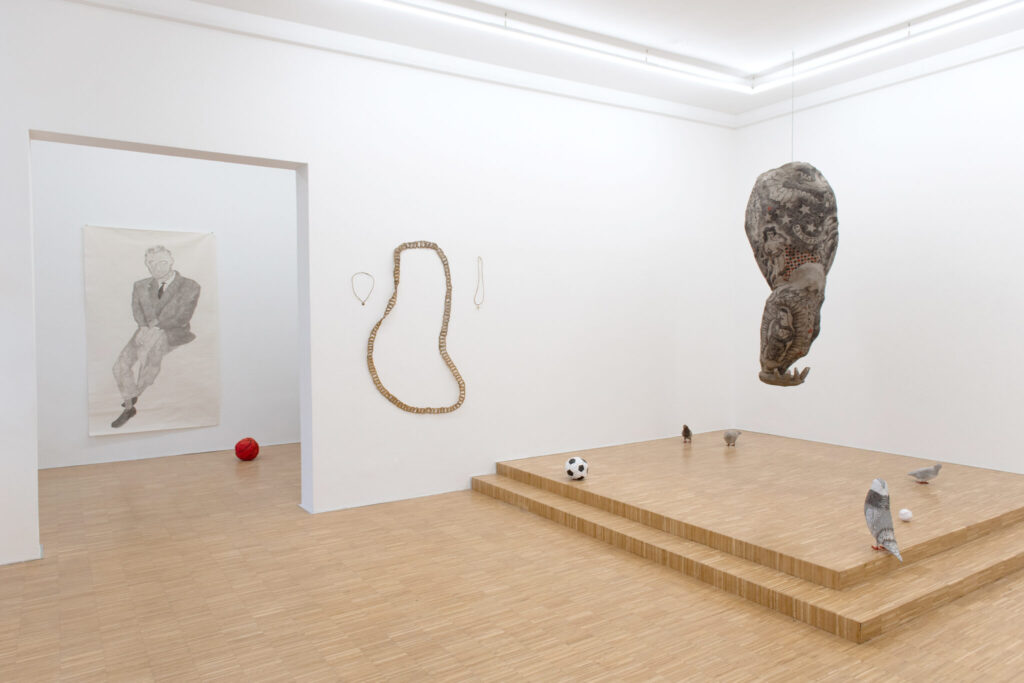
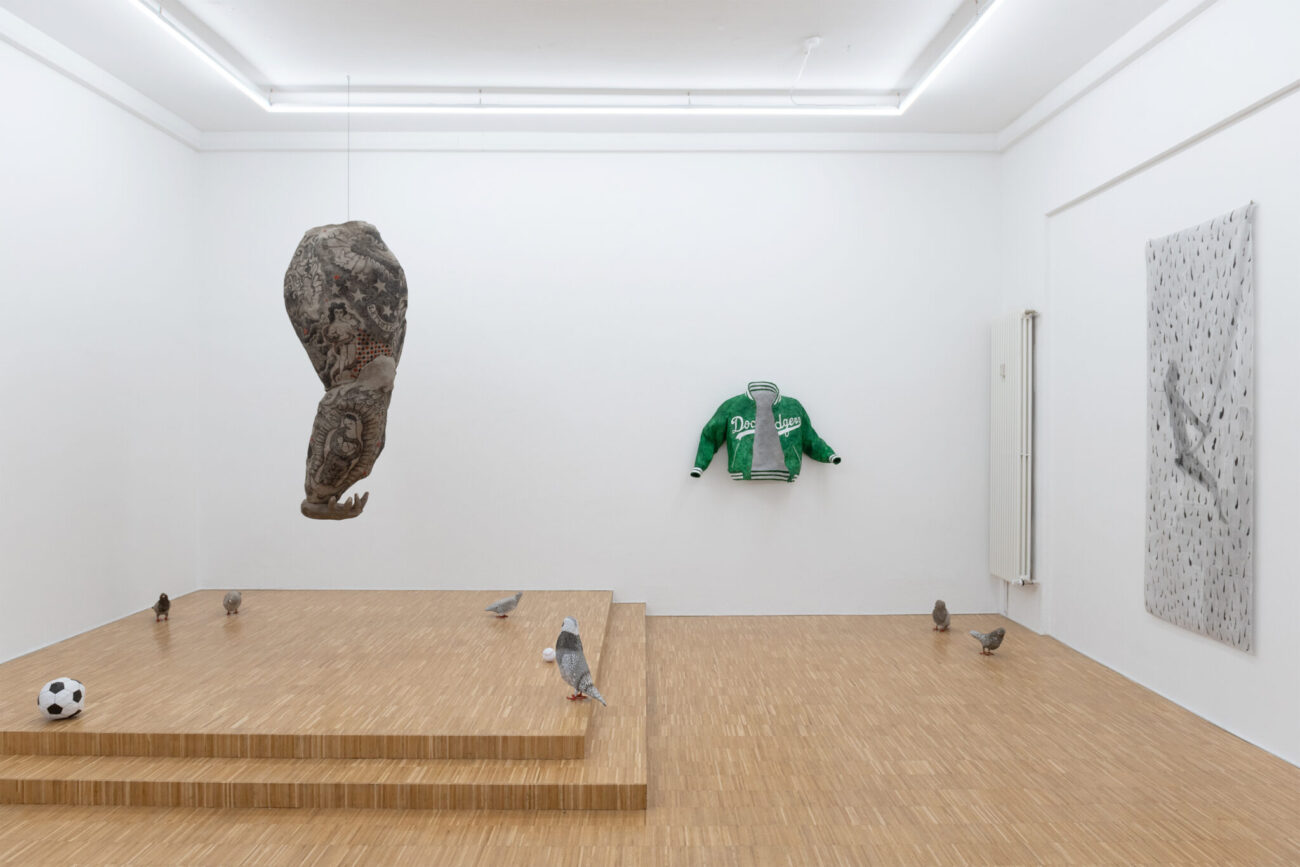
The exhibition does not simply present this archive, but translates it into various forms and formats within the space. Works on paper and large-format paintings on canvas are displayed alongside papier-mâché objects based on the same conceptual approach to materials. These works, too, are fundamentally drawing-based, yet exist in a different physical state. Günther combines chicken wire, pulp and layered paper, leaving the surfaces rough and porous. Formally, drawing remains the starting point for these sculptures too; they are, ultimately, drawn objects. Lines become volumes and hatching becomes surfaces with a physical presence of their own. The manufacturing process remains visible; smoothness or a perfect illusion are not the aim. The objects appear fragile, distorted and, at times, improvised.
This transition into the spatial is the logical consequence of an artistic approach that has long engaged with expansion, gradation and physical presence. With her large-format cut-outs and suspended canvas works, the artist expands the concepts of space, of foreground and background, of superimposition and layering. Life-size pigeons, an oversized tattooed arm, items of clothing, hats, sports equipment and status symbols – these paper sculptures complement the works on paper to form a coherent presentation.
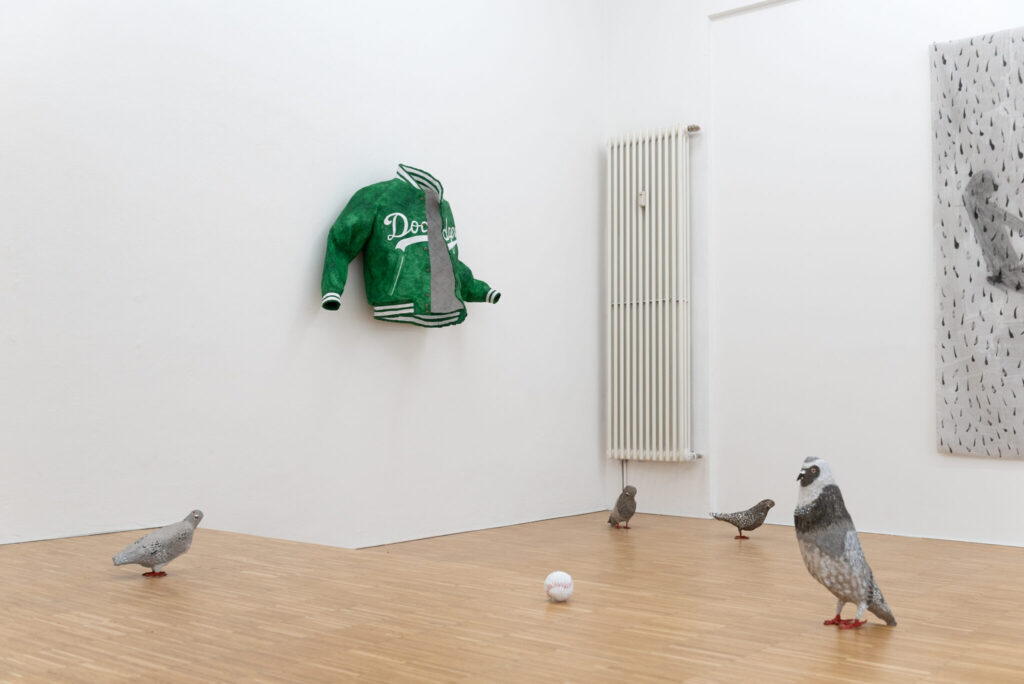
Günther’s works draw on culturally charged motifs such as baseball jackets, gold chains, hip-hop headwear, sports equipment and fragments of uniforms. These objects are often associated with forms of performative masculinity in sport, the military, and pop and subcultures. Their references range from the famous baseball player Willie Mays to the musicians of Run-D.M.C. and the author James Baldwin. High culture and popular culture, political history and the aesthetics of everyday life coexist side by side, without commentary or weighting. This non-hierarchical coexistence of diverse references and allusions reflects Günther’s biographically developed visual economy, shaped by an acquired longing for American popular culture – its music, films and literature.
When drawing and modelling with wire and papier mâché, these motifs undergo a process of deformation. Günther takes them up, reduces and condenses them, and places them in a new, alienating context. Perspectives shift, anatomies become distorted, and text fragments appear like fragmented thoughts. As the motifs are already laden with connotations as familiar cultural artefacts, it is left to the viewers to form their own associations and projections regarding the individual works and their arrangement within the space.
The Tiger Room, Heßstraße 48b (Eingang im Hof), 80798 Munich