What remains of a political movement when its audiovisual archive is fragmentary? What role do narratives, bodies and voices play when written documents are unable to adequately convey the experiences of those involved? And how can a collective heritage be conveyed poetically without having to transform it into a self-contained narrative? In a highly focused presentation of “The Circle Project” at La Casa Encendida in Madrid, the Moroccan-French artist Bouchra Khalili uses the history of the Mouvement des Travailleurs Arabes (MTA), an autonomous movement of Maghrebi workers in France, as the starting point for her artistic research. The themes she addresses are proving more relevant than ever in light of the current political shifts towards right-wing ideologies.
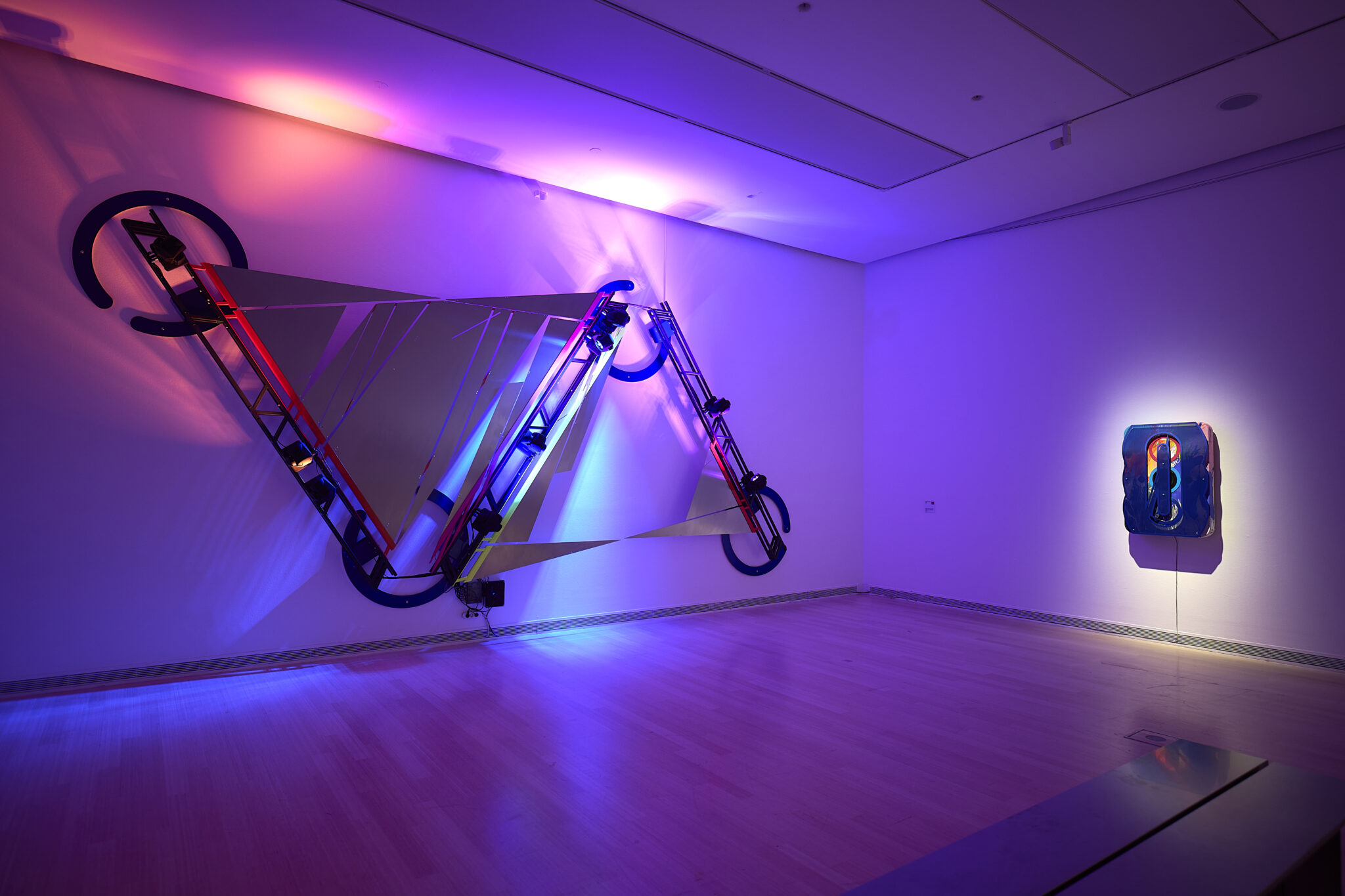
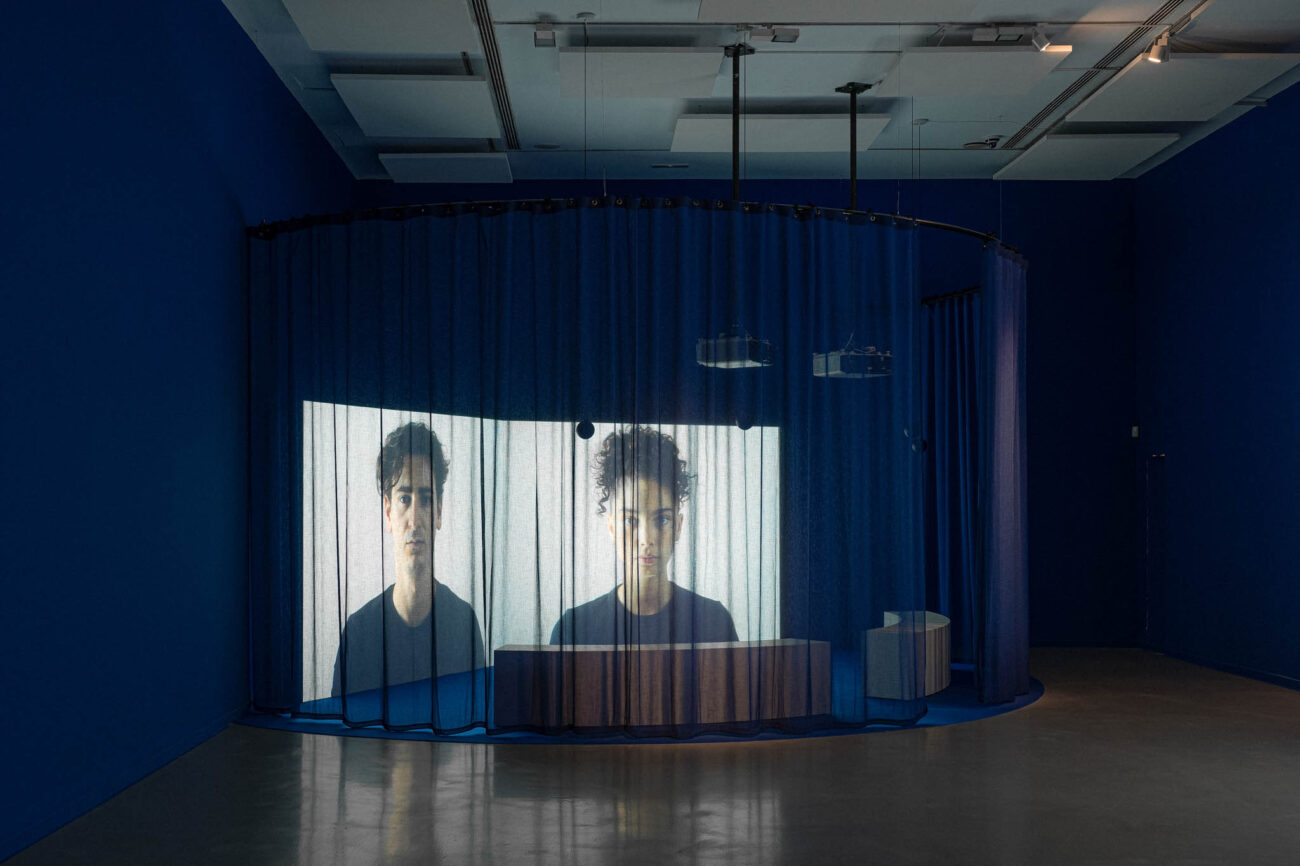
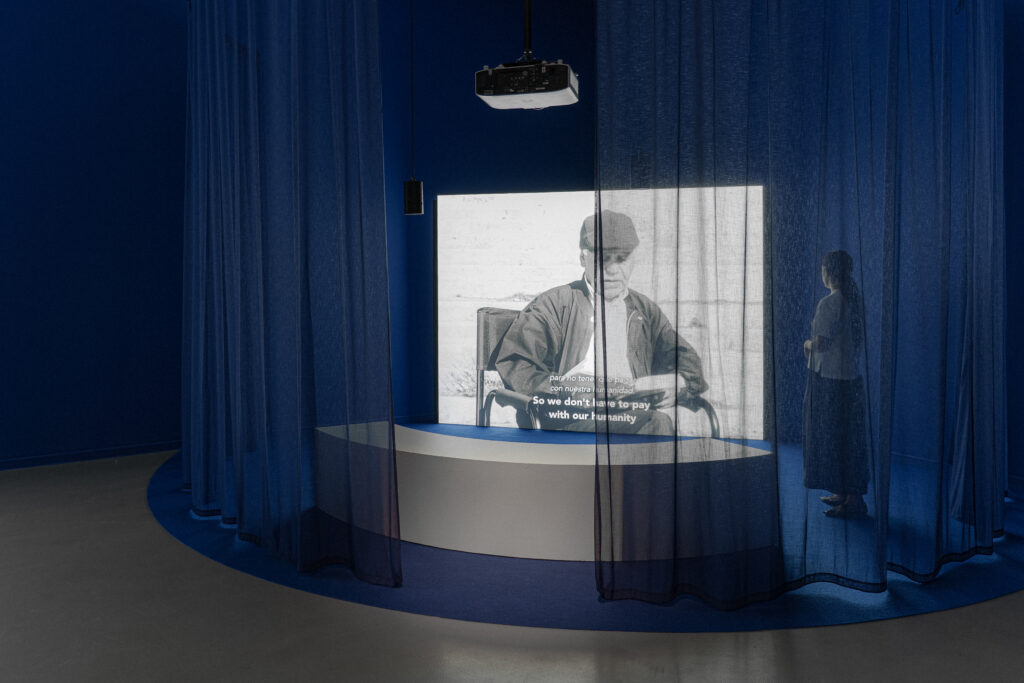
The exhibition space at La Casa Encendida is dominated by two semi-circular architectural interventions. Separated by light blue curtains, they form two private viewing areas in which screens display videos in front of benches. Although these spaces stand out from the institution’s architecture in terms of colour, they are accessible and invite visitors to watch the films. In these spaces, which resemble the dispositiv of a cinema, Bouchra Khalili screens the two essay films “The Circle” and “The Storytellers”.
These form part of the larger body of work known as “The Circle Project”, in which Bouchra Khalili explores how collective knowledge circulates, but also disappears, across time, media and social spaces. At the heart of the project is the history of the Mouvement des Travailleurs Arabes (MTA), an autonomous movement of Maghrebi workers in France, and the associated theatre groups “Al Assifa” (‘the tempest’ in Arabic) and “Al Halaka’”(‘the circle’ or ‘the assembly’ in Arabic). Khalili has developed this research over a period of around a decade, combining documentary methods with poetry, performance and cinematic montage. The result is a complex body of work that explores the conditions of belonging whilst also questioning how artistic practice and political agency can complement one another.
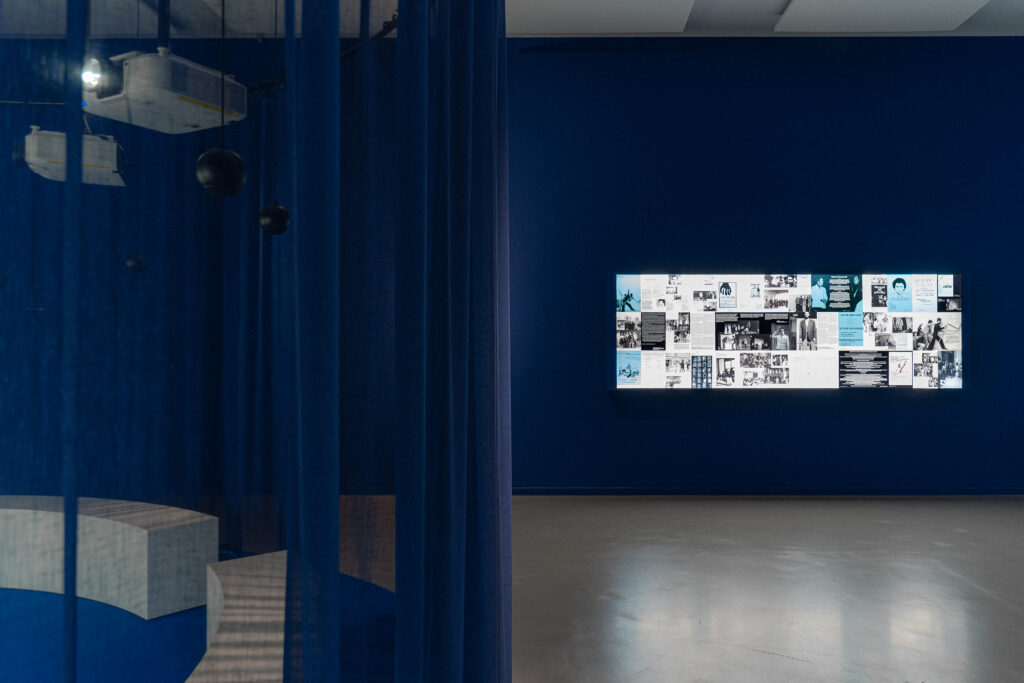
Positioned between the two film installations is the piece “Timeline for a Constellation”, as a visual and textual foundation for the artist’s research. The wall poster brings together documents, chronological details, archive material and other artefacts to trace the history of the MTA and its theatre groups between 1971 and 1974. Here, history is presented not as a chronological sequence of political events, but rather as a network of people, places, struggles and forms of solidarity. The historical research begins in the early 1970s, a period in which migrant workers from the Maghreb in France were confronted with racist violence, precarious housing conditions and the denial of political rights. Following a series of racist murders, the community organised a general strike led by migrant workers in 1973. It was out of this political context that the MTA emerged, championing the self-organisation of Arab workers and the demand for equal rights, economic participation and political representation.
The theatre played a central role in this. With “Al Assifa” in Paris and “Al Halaka” in the south of France, groups emerged that saw artistic expression as a tool for activism. Their performances explored everyday experiences of racism, exploitation and social marginalisation. At the same time, they developed a practice of public assembly: the theatre became a place where knowledge could be shared, experiences articulated and forms of collective action explored.
Khalili reflects this approach in her artistic strategy, using historical material in a poetic manner. Her approach is neither that of a traditional historical documentary nor an attempt to reconstruct a specific past as fully as possible. Rather, she examines the conditions under which history is passed down. These questions feature particularly prominently in “The Storytellers”, a film installation comprising five works shot on 16 mm film. Former members of “Al Assifa” and “Al Halaka” perform excerpts from their oral repertoire: sketches, poems and scenes that address racism, housing conditions and the living conditions of migrant workers. The bodies and voices of the protagonists create a temporal tension with the original performances. Five decades after their creation, the pieces are re-enacted, and with each repetition, their relationship to the (disappointing) present also changes.
At the heart of “The Circle”, the eponymous video installation, lies the encounter between two generations. Mia and Lucas, two young people of Maghrebi origin from Marseille, are researching the history of the MTA and its theatre groups. In doing so, they take on the roles of both narrators and editors. Their work combines eyewitness accounts, archive material, music and excerpts from the historical performances with discussions about the political significance of this history. This intricate and complex work operates on various levels: academic, musical, biographical and performative.
The story of Djellali Kamal, the pseudonym of a member of the MTA who wishes to remain anonymous, takes on particular significance. During the 1974 French presidential election campaign, he stood as a candidate whilst on hunger strike. The action was directed against the exclusion of millions of migrant workers from the right to vote and, at the same time, articulated a different conception of political belonging. The candidacy can be interpreted as a public performance whose political power lay precisely in the tension between real institutional exclusion and an imagined form of social participation. The performative fiction thus challenges the existing, exclusionary rules and systems and articulates a possible alternative.
Issues of citizenship, migration and political and economic participation in Europe continue to be linked to institutional exclusion and contradictory notions of political community. Whilst Khalili’s individual works can be viewed as stand-alone investigations, they realise their full impact through interaction and exchange. Khalili uses the history of the MTA as a starting point for a profound and poetic reflection. She refers to struggles that were already being addressed decades ago through forms of self-organisation, cultural autonomy and transnational solidarity. A protagonist in “The Circle” describes the situation as follows: ‘Whether you’re French or a migrant, you both have the same exploitative boss.’ Perhaps the best way out of systematic injustice lies in cross-ethnic solidarity.
La Casa Encendida, Rda. de Valencia, 2, Centro, 28012 Madrid
Text: Quirin Brunnmeier