Art and nature, mystical experiences and a rediscovery of the world’s magic. The Gherdëina Biennale showcases contemporary art against the stunning backdrop of the Dolomites, enchanting visitors in the process. And whilst you’re in the area, you shouldn’t miss the Museion and the Fondazione Antonio Dalle Nogare.
South Tyrol is renowned for its stunning scenery, excellent wine and warm hospitality. Angela Merkel isn’t the only one who enjoys holidaying here. But amongst the vineyards, bizarre rock formations and rushing mountain streams, one can also discover outstanding contemporary art. The Museion is Bolzano’s institution for contemporary art, and its director, Bart van der Heide – who previously headed the Kunstverein in Munich – is implementing ambitious projects there. Currently, two exhibitions are spotlighting artistic approaches that tend to occupy a peripheral position in art history: the kinetic artist Erika Giovanna Klien and the Filipino artist, poet and activist David Medalla. The Fondazione Antonio Dalle Nogare is a real surprise. In addition to a collection of conceptual and minimalist art from the 1960s and 70s, the foundation also presents temporary exhibitions. With ‘FROM B TO E AND MORE’, the foundation pays tribute to the work of the German artist Charlotte Posenenske, who is one of the most renowned figures in German Minimal Art. She brought her short career to an end herself in 1968 by turning her back on art to devote herself to sociology. The modern, almost brutalist architecture of the Fondazione Antonio Dalle Nogare nestles elegantly within a vineyard, blending nature, culture and architecture.
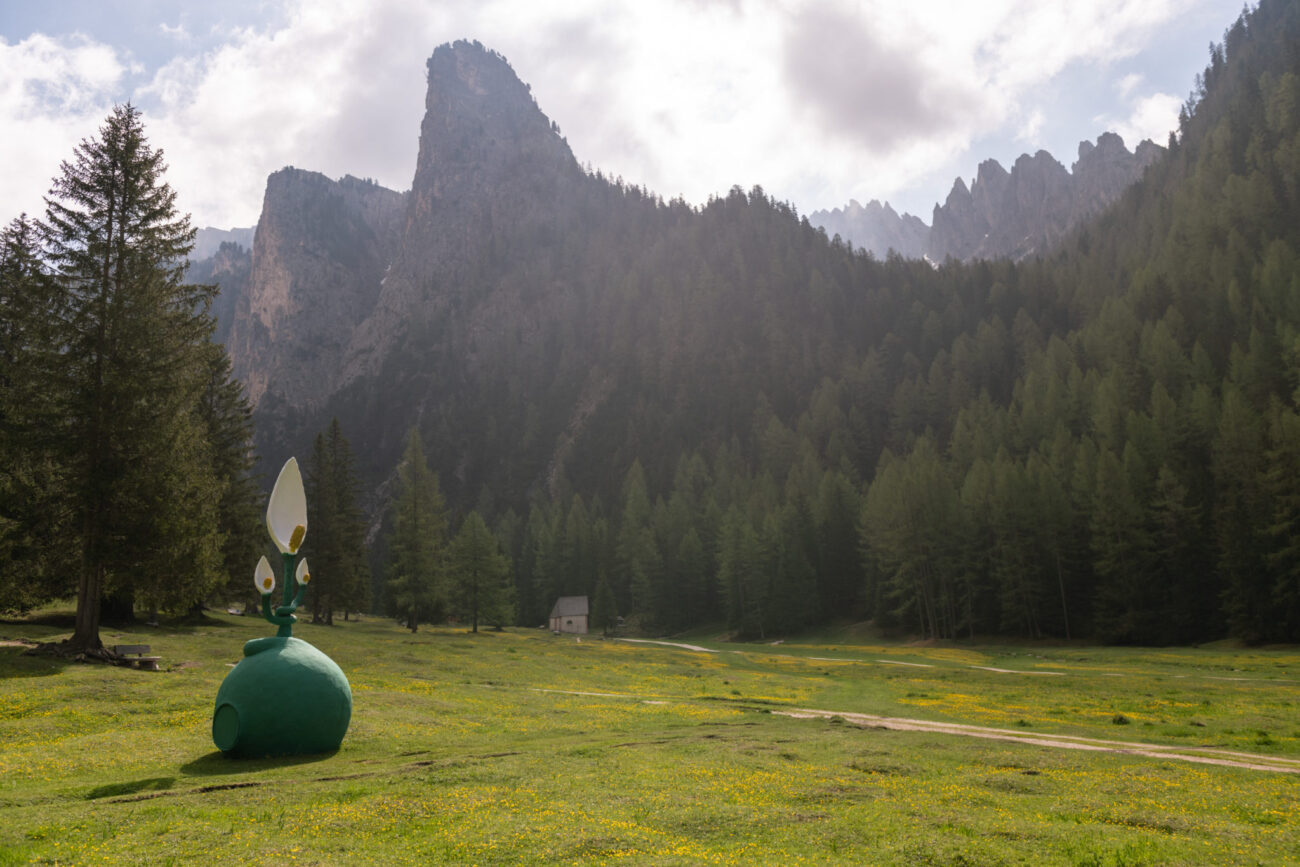
The eighth edition of the Gherdëina Biennale also explores the intersections between culture and nature, tradition and modernity, regional identity and internationalism. Under the title “Persones Persons”, curators Lucia Pietroiusti and Filipa Ramos present a series of installations, sculptures, sound works, performances, textile works and participatory projects, all set against the backdrop of the stunning landscape of the Val Gherdëina in the Dolomites. The artists are exhibiting not only in traditional exhibition spaces in the valley’s villages, but also in a derelict hotel dating from the 1960s, a 17th-century castle, and the truly magnificent natural surroundings. At the heart of the Biennale is a museum exhibition featuring, amongst other works, sculptures and paintings by Judith Hopf, Jimmie Durham and Britta Marakatt-Labba. The truly interesting projects, however, can be experienced in unconventional locations. The Argentine artist Eduardo Navarro has placed his “Spathiphyllum Auris” in an unspoilt stretch of wilderness high in the mountains. The oversized sculpture of a peace lily seems somewhat out of place amidst this scenic beauty, as if a detail from a painting by Hieronymus Bosch had strayed into the mountains. Nevertheless, the work blends into its surroundings and appears to establish a connection with them.
The participatory work of the artist, poet and choreographer Alex Cecchetti offers another form of engagement. His project “Sentiero” provides participants with an intimate, individual experience in the form of a performative walk. Led by performers, participants move along a mountain path through the natural landscape. The guides take on the role of spiritual mediators; their language is poetic, mystical and almost incantatory. They draw attention to details in nature, ask questions and aim to heighten participants’ sensitivity not only to nature but also to their own perception of the world. The walk, which lasts almost two hours, ends in a clearing by a yurt, where water and a cup of regional mushroom soup are served. Refreshed and feeling rather moved, you are then set off on the solitary walk back. Like many of the works on display at this Biennale, “Sentiero” is poetic without being kitsch, mystical but not esoteric.
Another venue for this biennial is the Fischburg, a medieval-style castle deep in the Val Gherdëina. Artists are bringing the inner courtyard of these crumbling walls to life with installations, sculptures and videos. In an adjoining room, Chiara Camoni has placed her sculpture ‘Sister’. The clay sculpture is half goddess, half sorceress. Candles burn in some of her six arms, as if in a shrine. She does not reveal which faith this mythical being represents, but she bestows a benevolent smile upon the viewer. In front of the Fischburg, the duo Ignota – comprising Sarah Shin and Ben Vickers – have created a “Memory Garden”. Drawing in part on the ideas of Hildegard von Bingen, the circular herb garden references the lunar cycle, whilst a sound installation adds an auditory dimension to the piece. In this garden, ideas are meant to sprout like seeds and unfold their power.
A side valley in the heart of the Alps is an unusual venue for a biennial of contemporary art. Nevertheless, the two curators have managed to weave a dense network of works which, whilst not all fitting neatly under the curatorial umbrella, nonetheless each unfold their own power. The works are united by a certain utopian ethos, questioning the role of humankind in the context of the world. At times, however, the line between spirituality and otherworldly escapism does seem very fine. Nevertheless, the Gherdëina Biennale is not an idea devised by the local tourist office to lure visitors with an interest in art – and supposedly high purchasing power – into the valley, but rather an ambitious project dedicated to current discourses and presenting relevant perspectives.
Biennale Gherdëina “Persones Persons” – Val Gherdëina, 39046 Ortisei, BZ, Italy
Our review to the Biennale Gherdëina 2024 can be found here.
Our review to the Biennale Gherdëina 2026 can be found here.