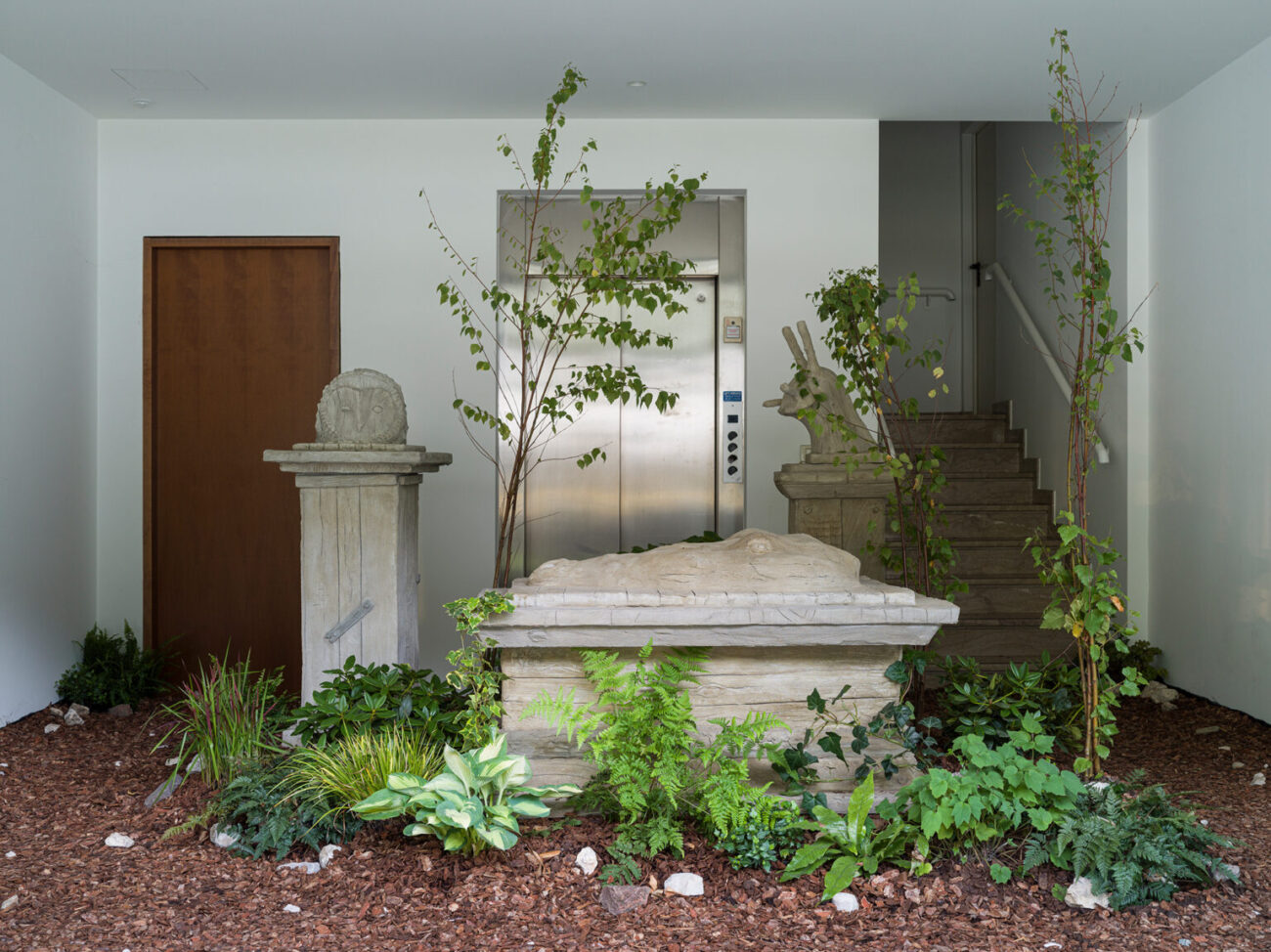
Between the geological past and an ecological future. Under the title “The Parliament of Marmots”, the 9th edition of the Gherdëina Biennale presents a selection of international artistic proposals. The works explore the tension between nature and humankind, between primal states and domestication.
This gigantic skeleton seems almost unreal amidst the impressive, still snow-capped peaks of the Dolomites. On a secluded high plateau, the Swedish artist Ingela Ihrman has installed her large-scale work ‘First Came the Ocean’, which is modelled on the structure of a marine creature that lived more than 250 million years ago in what is now the Dolomites. The sculpture is composed of found trunks and branches from local trees that had been weakened by a bark beetle infestation and toppled by storms. In her work, Ihrman combines current environmental issues with the geological history of this mountain range, whose rocks consist of sediments from coral reefs and whose meadows were once the seabed.
This sculptural intervention into the fabric of space and time forms part of the 9th edition of the Gherdëina Biennale in South Tyrol. Entitled “The Parliament of Marmots”, it brings together works by artists of various nationalities at different locations throughout the Val Gardena until 1 September. Curated by Lorenzo Giusti, supported by Marta Papini as associate curator, this multifaceted exhibition aims to present a hybrid mosaic of artistic proposals and interconnect complex layers. The aim is to explore the existential dimension of the ‘wild’ in a technologised and civilised world, to open up new origins and perspectives, and to interconnect the natural and narrative spaces of the Alps and the mountains of the Mediterranean region.
The title of the Biennale refers to the Ladin myth of the Kingdom of the Fanes, a gentle people whose realm stretched to the proverbial ends of the earth. The secret to this people’s prosperity lay in their alliance with marmots. Central to this myth are themes of transformation and metamorphosis, untamed nature, the cyclical balance between life and death, and the relationships between different species. The Biennale as a whole comprises commissions, performances, solo and group exhibitions, as well as collaborations with regional cultural institutions. The art can be found at various locations throughout Val Gherdëina. Right at the entrance to the valley, visitors are greeted by a sculpture by the French-Tunisian artist Alex Ayed. “Untitled (Beit el hmam II)” is a traditional dovecote made of olive wood, straw and clay. Presented in a new context and as a sculpture, this object alludes to the complex, multi-layered and deeply hierarchical relationship between humans and non-human beings.
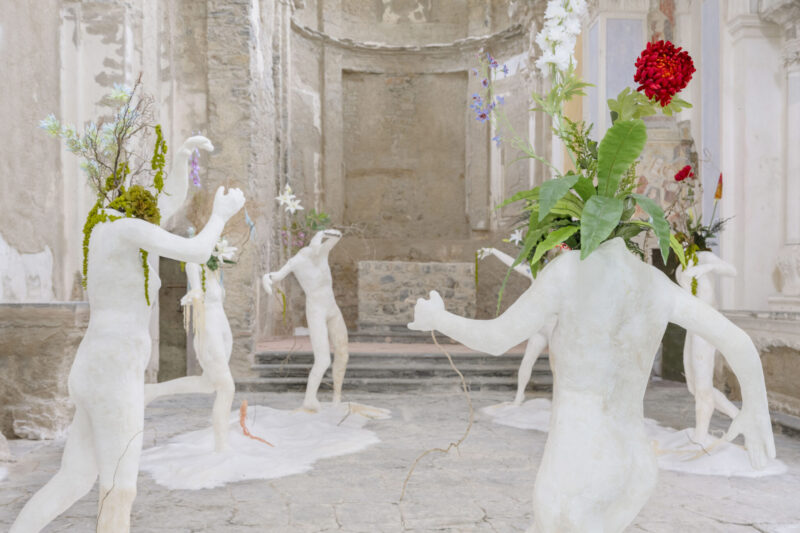
Sculptures and installations can also be seen at the Val Gardena Castle in Wolkenstein, at the Gherdëina Museum and in the centre of St. Ulrich. The Sala Trenker there is hosting a retrospective of the sculptor and animal rights activist Lin May Saeed, who passed away in 2023. Her delicate sculptures and reliefs, made from polystyrene, explore the relationship between humans and animals. Her distinctly narrative works draw on fables and myths from ancient Mesopotamia as well as Christian and Islamic traditions. Her cross-cultural narratives explore structures of exploitation, but also envision possible utopias of peaceful coexistence in a shared future. The exhibition has been organised in collaboration with the GAMeC in Bergamo, whose director is Lorenzo Giusti.
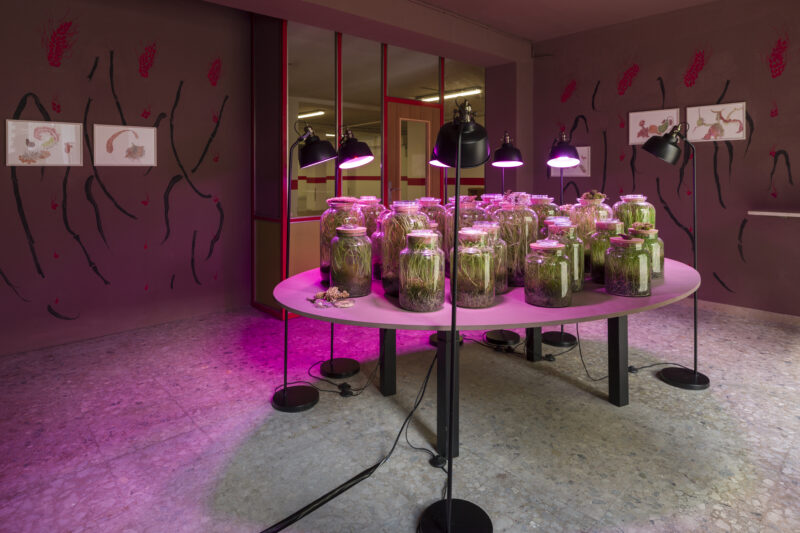
A little further down the valley, in Pontives, the Spazio Stufflesser hosts a focused group exhibition that feels like the very heart of the entire Biennale. The works on display – videos, sculptures and paintings – coalesce into a dense network in which the Alpine ranges are interwoven with the mountains of the Middle East, temporal planes are breached and myths are linked together. Viewed from the perspective of geological time, in which the Dolomites are regarded as a ‘young mountain range’, these relationships undergo a fundamental shift and our narratives become wafer-thin layers in the sediment.
Throughout the summer, the Biennale Gherdëina 9 offers a public programme featuring workshops, performances, talks and forest walks to explore the history of the Dolomites and the richness of their flora and fauna.
Lorenzo Giusti also curated “Thinking Like a Mountain” at the GAMeC Museum in Bergamo.
Biennale Gherdëina “The Parliament of Marmots” – Val Gherdëina, 39046 Ortisei, BZ, Italy
Our review to the Biennale Gherdëina 2022 can be found here.
Our review to the Biennale Gherdëina 2026 can be found here.