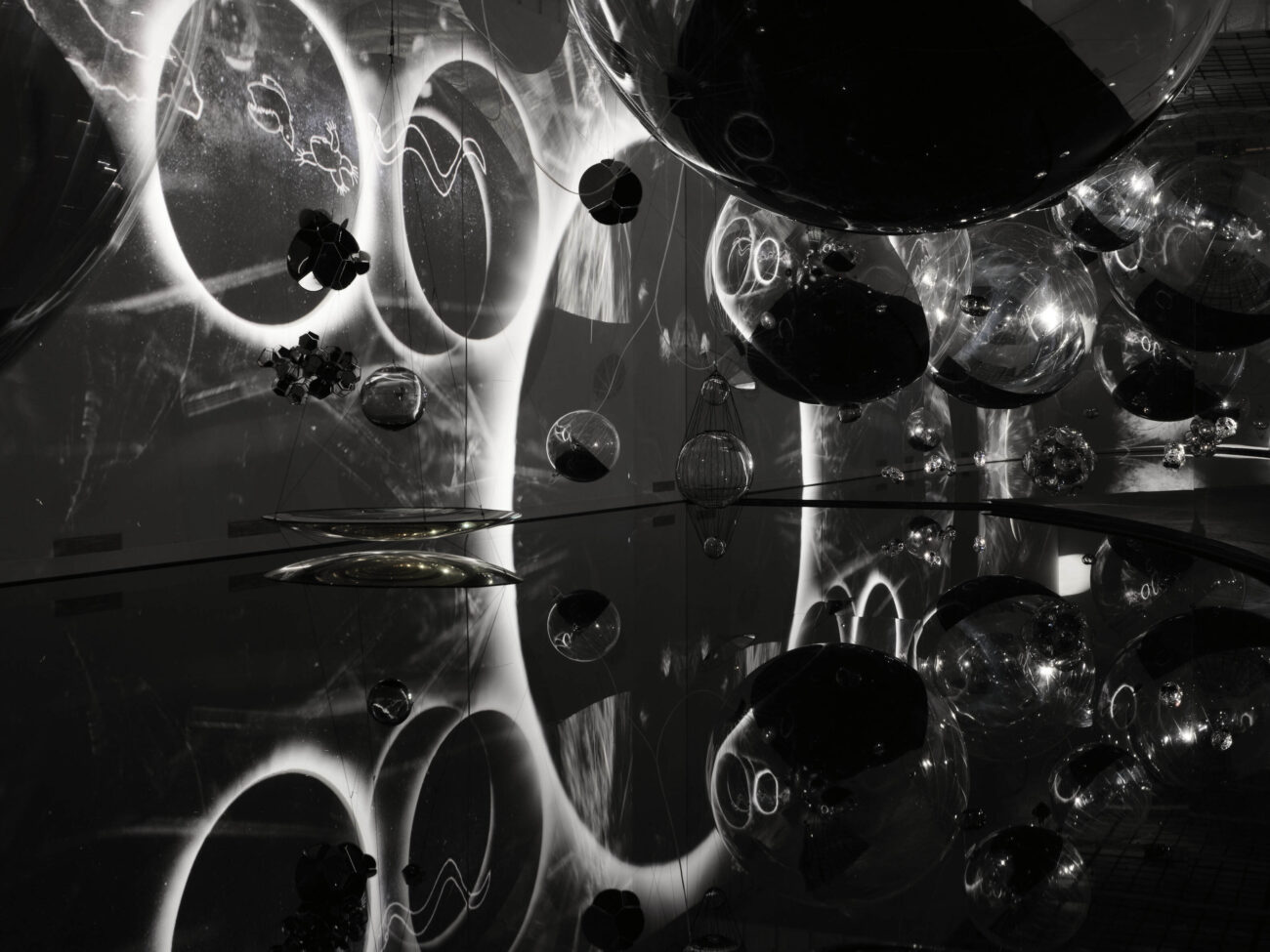
Floating sculptures, documentary material, sound and light works, and large-scale installations. In a comprehensive exhibition at the Haus der Kunst, Tomás Saraceno presents his interwoven cosmos, occupying a large area on the ground floor of the building. Air, water, vibrations, dust and light form the fundamental elements of his work. The exhibition eschews a linear narrative; instead, connections emerge between individual works, spaces, fields of knowledge and geographical locations, which become increasingly apparent as visitors make their individual way through the exhibition.
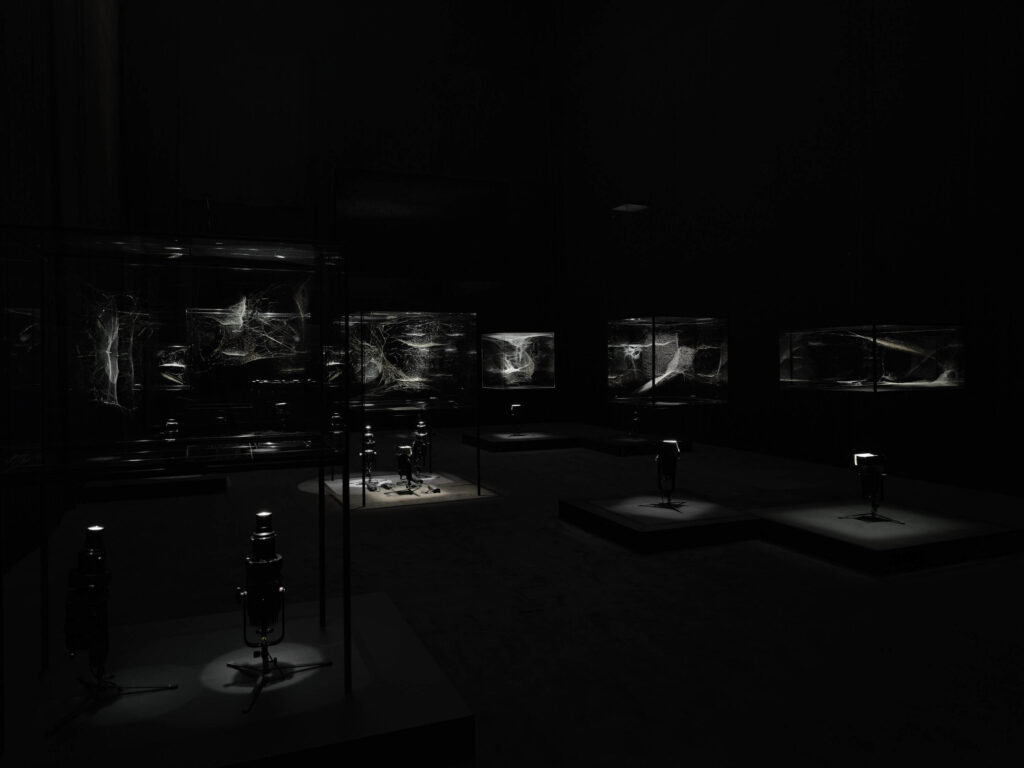
In the darkened room, these fragile systems appear like precious artefacts behind glass, skilfully staged with the aid of spotlights. In his current exhibition at the Haus der Kunst, Tomás Saraceno is presenting, amongst other things, a selection of real spider’s webs from various species of spider. These complex geometric structures appear both organic and mathematical, like woven cotton wool or models of star nebulae in distant galaxies. This theme, which spans the spectrum from the microscopic to the cosmic, runs through the entire exhibition.
Networks, connections and collaborative approaches form part of Tomás Saraceno’s core artistic vocabulary. Through his transmedia strategies, he links fundamental processes with biological structures, scientific research with artistic imagination, and ecological issues with social relationships. The exhibition “Tomás Saraceno in collaboration. Verwobene Welten” at the Haus der Kunst brings these different levels together in a comprehensive manner. Curated by Sarah Johanna Theurer and Andrea Lissoni, the exhibition is not, however, a traditional retrospective; rather, it reorders Saraceno’s works, thereby allowing visitors to experience the diverse connections and references that characterise his practice.

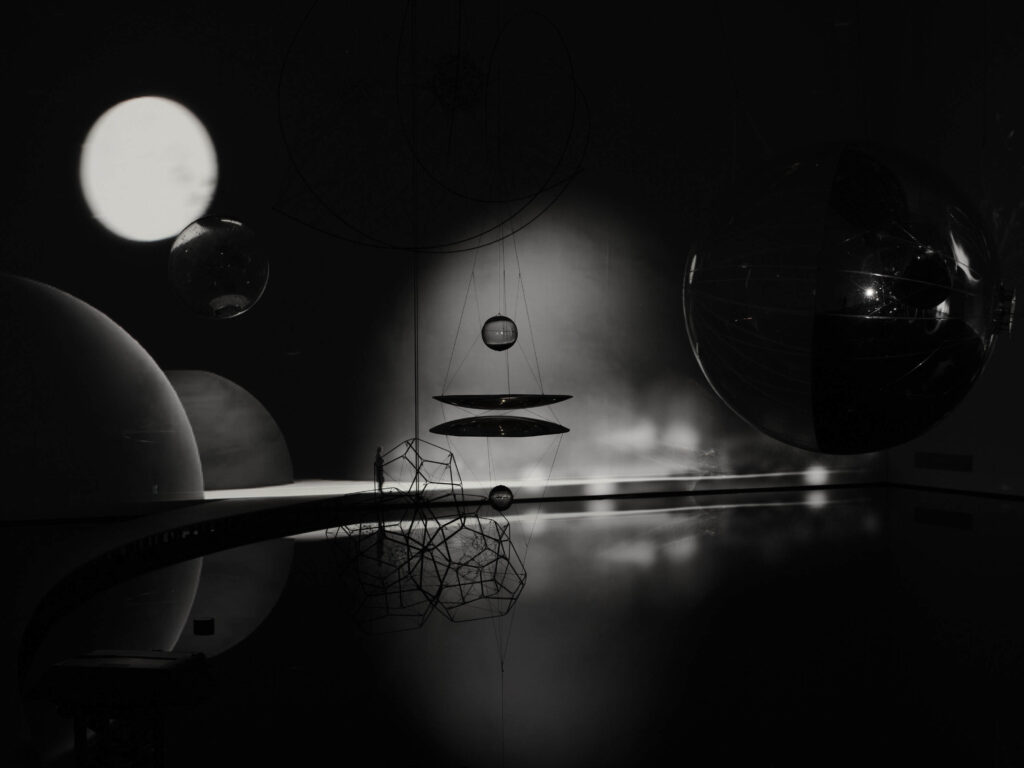
The monumental installation ‘Towards the Sanctuary of Water’, which forms the centrepiece of the exhibition, resembles a cosmic dreamscape. Pools of water, reflections, light, floating globes and projected images come together in the semi-darkness to create an environment whose appearance is in constant flux. The space feels both open and focused. Visitors move freely amongst reflections and shadows, thereby becoming part of this immersive, enigmatic and poetic installation. In the next room, one discovers how this work is simultaneously complemented and mirrored on the other side of the world. Here, one enters a bright hall; the floor is extensively covered with white salt, whilst wall panels, display cases and videos illustrate the global scope of this project. ‘Towards the Sanctuary of Water’ has its origins in Saraceno’s long-standing collaboration with the indigenous communities of the Salinas Grandes salt flats in the north of his native Argentina. Together, they are developing ‘The Sanctuary of Water’ (El Santuario del Agua) there – a permanent land art project dedicated to protecting water resources, traditional knowledge and the communities’ territory in a region increasingly threatened by aggressive lithium mining. Here, Saraceno addresses, on an artistic and scientific level, the globally relevant issues of water consumption and wastage, sustainability and the protection of indigenous communities in the age of the Capitalocene, in which everything is subject to a relentless capitalist economic system.
In the next room, a single, extremely bright light source casts its intense beam diagonally through the darkness. Once your eyes have adjusted to the darkness, you begin to see the dust particles dancing within the cone of light. It is the ordinary dust particles present in the air that are made visible here and, like cobwebs, are reminiscent of star clusters in the depths of the universe. Amidst all the crises and global problems, one must surely recognise we are, after all, nothing but stardust in the vastness of space.
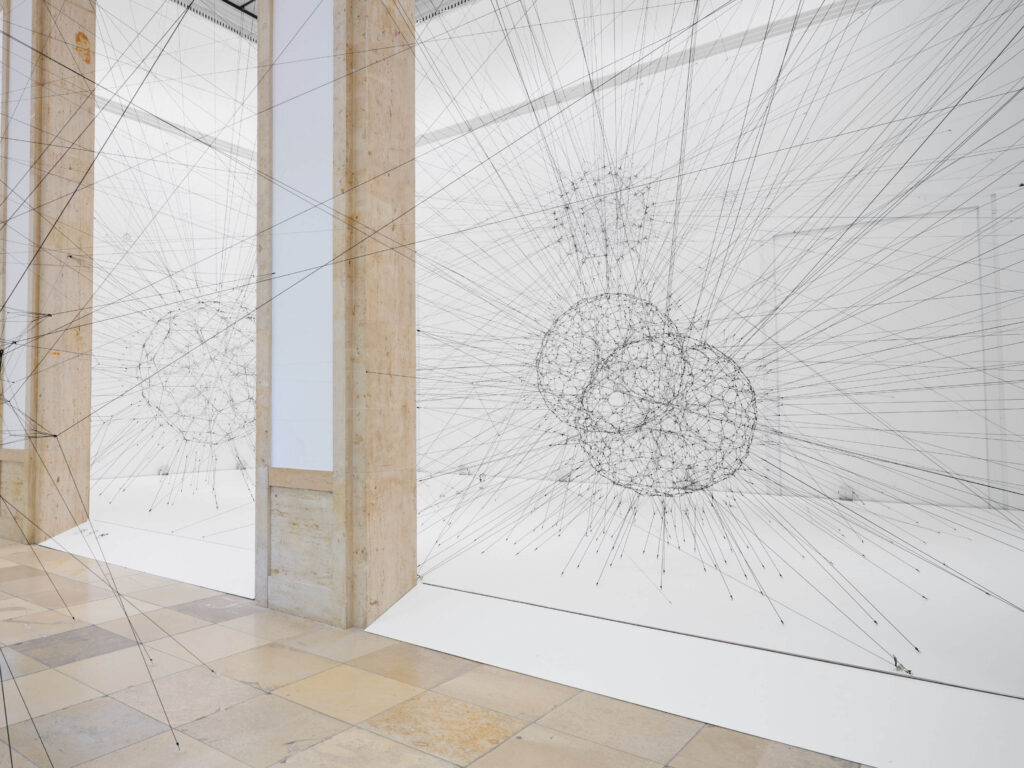
The equal coexistence of scientific approaches, political themes and poetic works of art is one of the strengths of this exhibition. Tomás Saraceno blends artistic approaches with research to explore ecological and social issues that extend far beyond the exhibition itself. The focus is not simply on conveying background information or providing educational supplements. Rather, these different perspectives are woven together into a new whole that becomes increasingly dense and is held in check by cross-connections. The spiders’ webs mirror the networks of communities; the microscopically small is reflected in the cosmically large; salt and water recur time and again. The collaborative approach implied by the title ‘Tomás Saraceno in collaboration.’ is also evident in the actual collaboration with scientists, biologists, architects and activists from indigenous communities. Even the spiders are close accomplices here.
Tomás Saraceno’s exhibition has two titles. The German version, ‘Verwobene Welten’, refers to the complexity of our present day, to interdependencies, but also to our shared responsibility for our planet and its inhabitants. The English title, “Ancestral Futures”, refers to the book “Ancestral Future” by the indigenous thinker and activist Ailton Krenak, in which he warns of the power of capitalism and its destructive effects. Saraceno deliberately uses the plural form of ‘future’, thereby optimistically pointing to different possible futures in which we can collectively create a sustainable world beyond the current constraints of growth.