The exhibition “Seeing the Unseen” at the ERES Foundation in Munich combines strategies of contemporary art with current quantum physics and seeks to highlight structural parallels between the disciplines. In fact, in both fields, the observer is not neutral but rather a constitutive part of the system. The art on display reflects, through its complexity, the multidimensional nature of quantum physics, thus becoming a space of resonance for a science that largely eludes intuitive imagination.
In recent years, certain technological and scientific developments have gained immense momentum. Cars drive themselves, and new vaccines are being developed in record time. Artificial intelligence is taking on increasingly complex tasks and has the potential to challenge our self-image as thinking and acting human beings. The potential disruptions are immense and quite frightening. Humanity is developing technologies that are radically transforming our present and our future.
The exhibition “Seeing the Unseen” explores a field of science that challenges our understanding of reality at a fundamental level. Quantum physics examines the behavior of matter and energy at the atomic and subatomic scales. The fundamental concepts of quantum physics subvert the rules of classical physics: dualities are possible; probabilities are used instead of specific quantities; and often, counterintuitive realities only manifest themselves through the act of measurement itself.
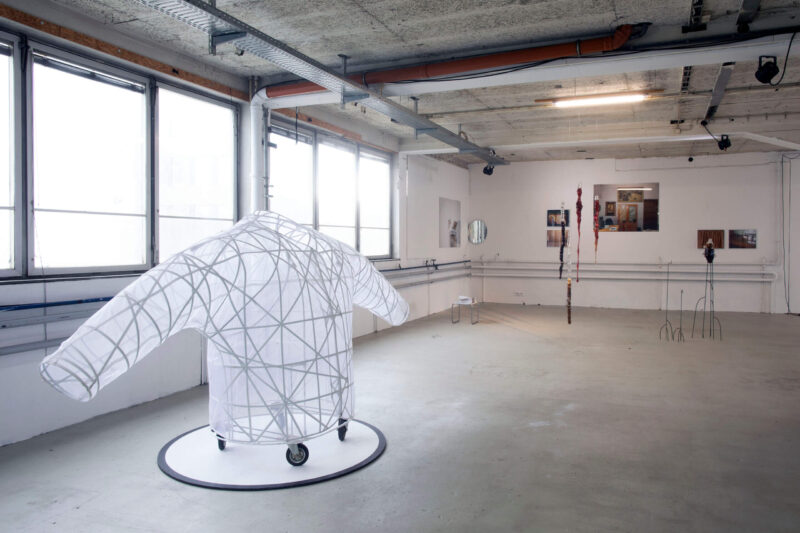
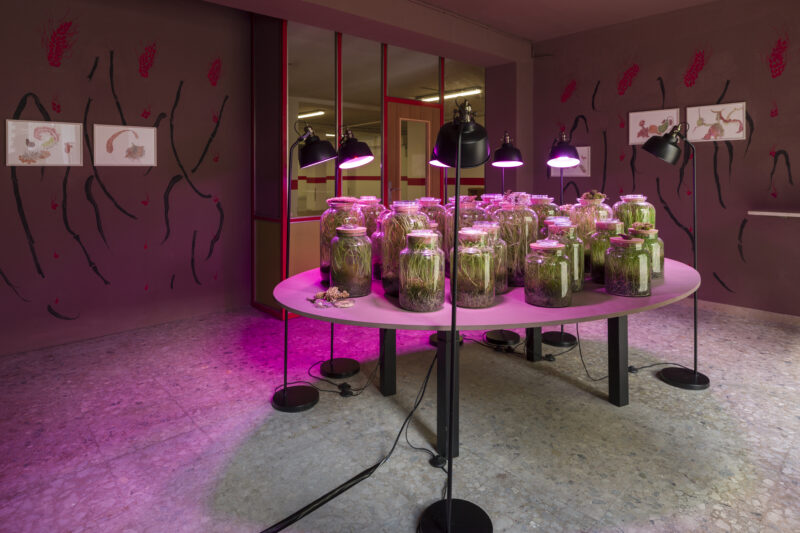
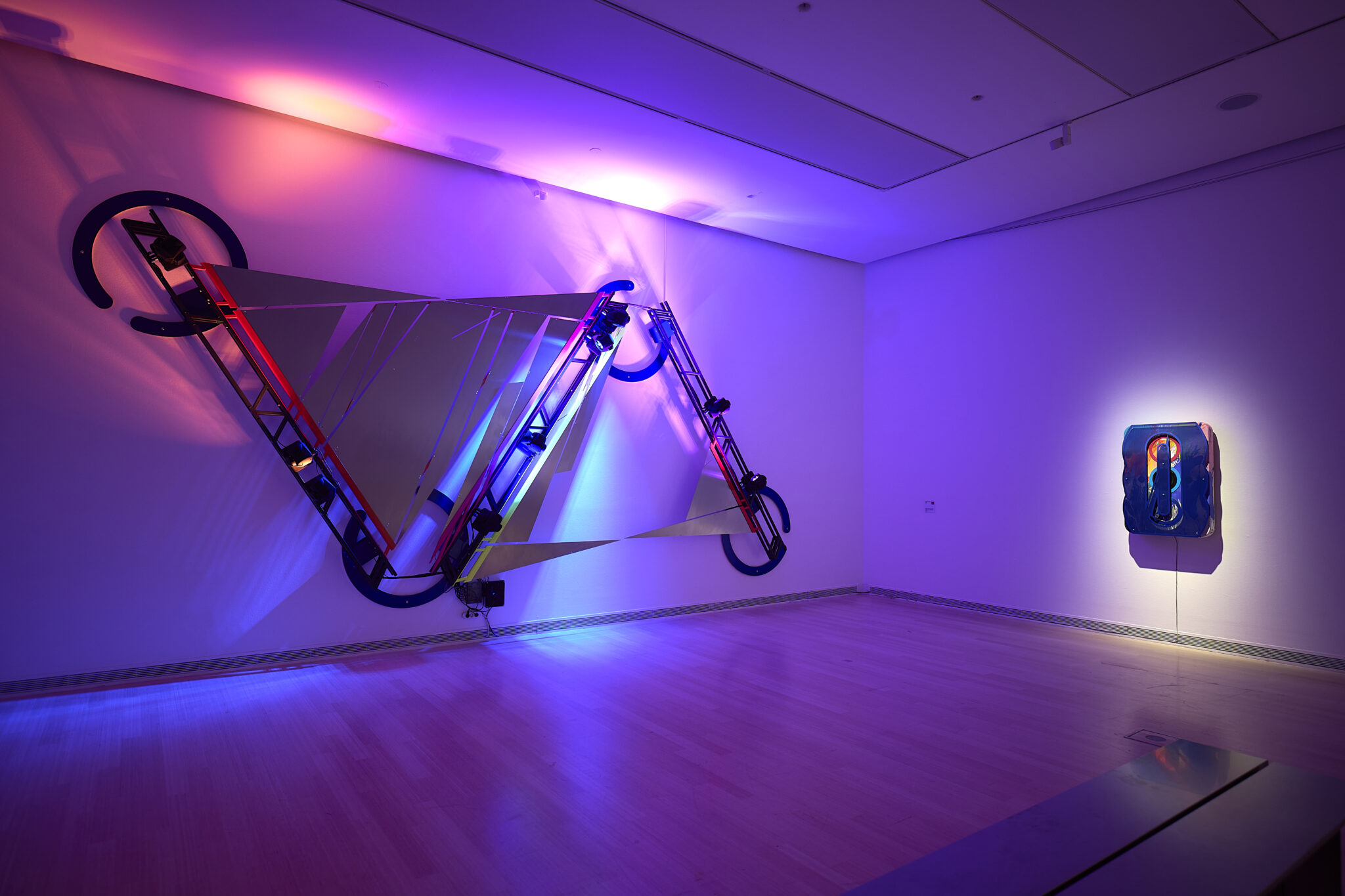
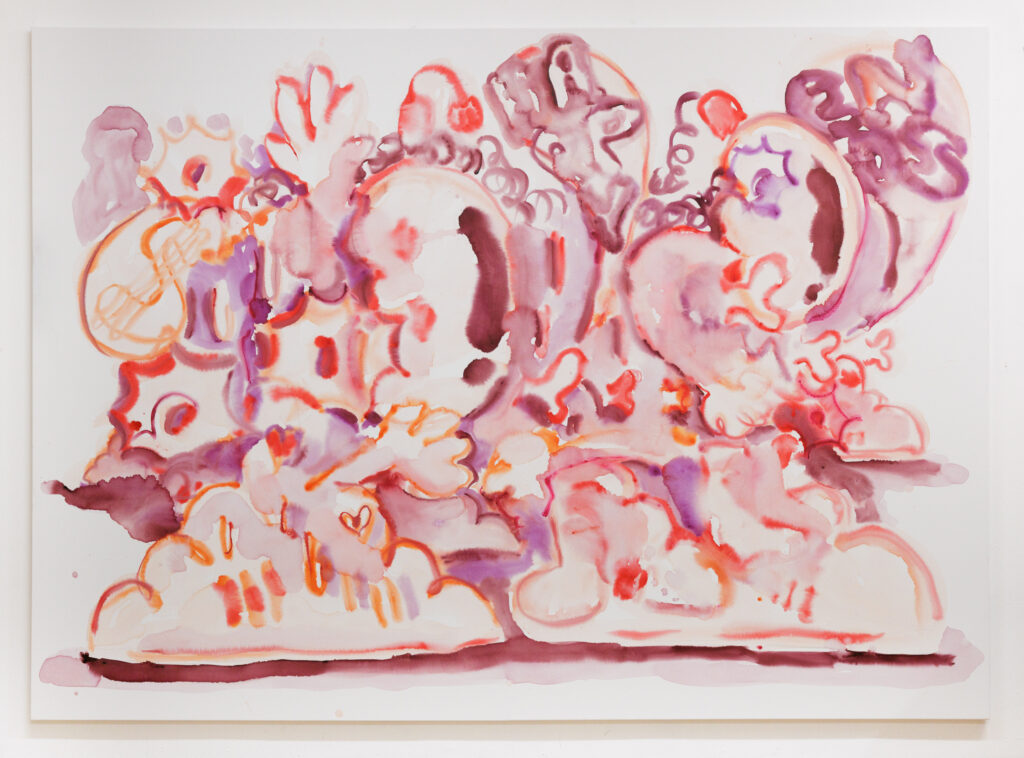
Quantum physics is a highly complex science that cannot be precisely conveyed through words or images. The language of quantum physics is mathematics; therefore, the objects and images displayed in the exhibition cannot illustrate quantum physics either. The exhibition’s curator, Dr. Sabine Adler, has selected works of art that engage in various ways with concepts of quantum physics such as superposition, entanglement, and observer dependence. The range of works on display extends from drawing and painting to sculpture, video, animation, and immersive mixed-reality installations.
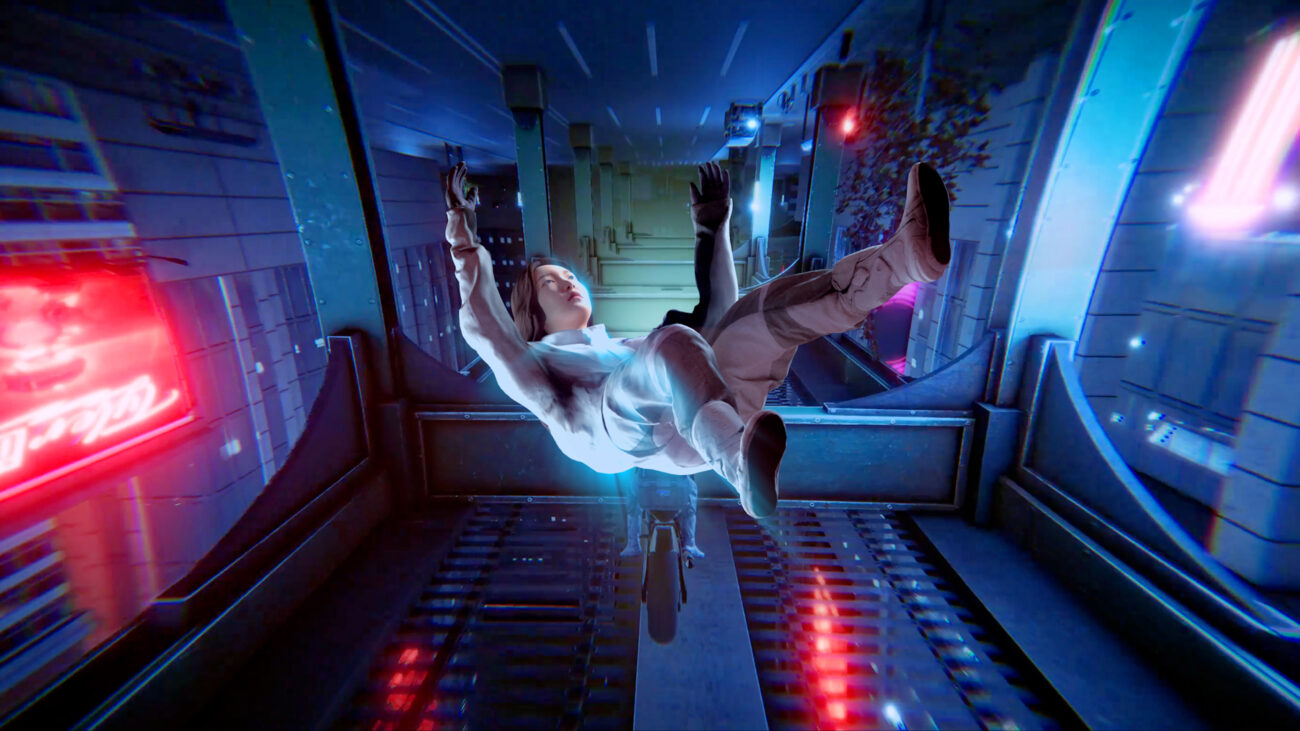
Ayoung Kim creates a speculative quantum reality in her immersive video installation “Delivery Dancer’s Sphere.” Through rapid cuts and shifting perspectives, viewers follow a female motorcycle courier as she races through futuristic urban landscapes. Along the way, the protagonist encounters herself, sees her own reflection, and her distinct position dissolves. Narrative strands overlap, and time and place become indistinguishable. Kim employs nonlinear narrative structures to make concepts such as simultaneity and parallelism tangible. AI-driven algorithms constantly issue new instructions to the character, pointing to a world in which individual freedom of action is increasingly determined by data-driven systems. Straddling the realms of science fiction, video game aesthetics, and a critique of social reality, the work unfolds the power of a poetic allegory in which the boundaries between physical bodies and virtual entities ultimately dissolve.
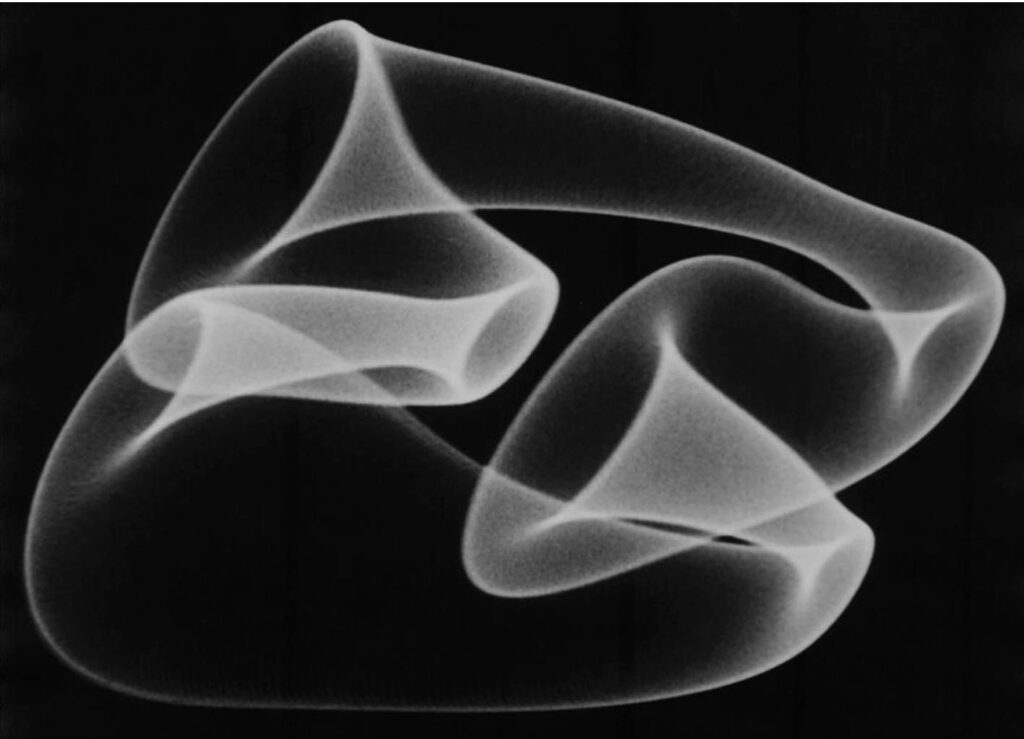
The images in Herbert W. Franke’s series “Dance of the Electrons” also have a sensual and almost ethereal quality. Born in Vienna in 1927, this polymath is considered one of the pioneers of computer art and mathematical art. As a physicist, cyberneticist, artist, and author, he operated from an early stage at the intersection of science, technology, and aesthetics. As early as the 1950s, Franke was experimenting with generative techniques. Together with physicist Franz Raimann, he developed an analog computer in 1954, which was used to create the series shown here. Oscillation patterns were visualized on an oscilloscope and then captured photographically. Today, these ghostly formations are regarded as early attempts to visually capture quantum physical processes. In the exhibition, Franke’s works appear surprisingly contemporary: they demonstrate that the artistic endeavor to make the invisible visible has accompanied quantum physics since its very beginnings.
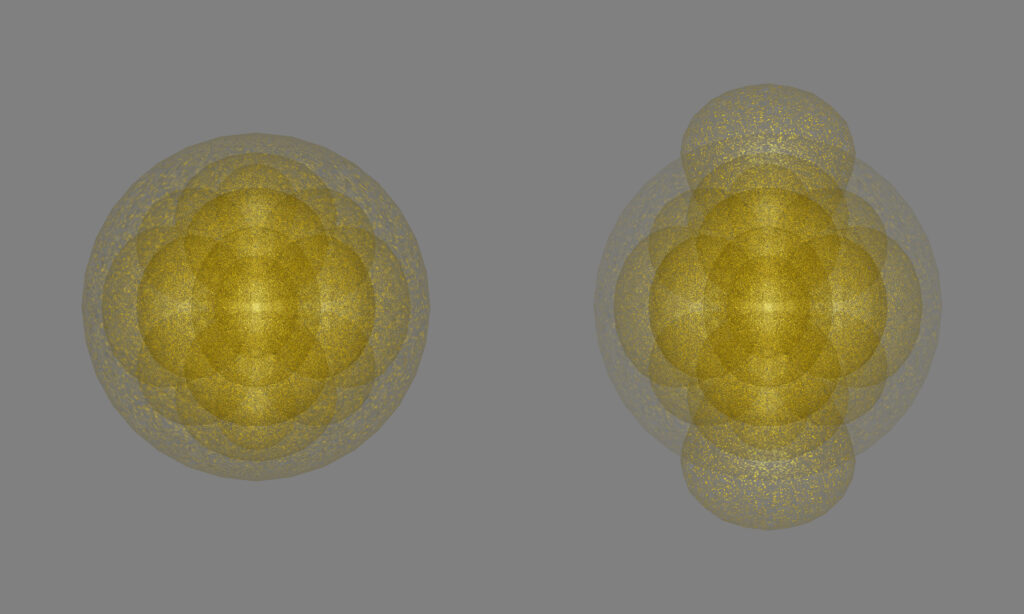
Tamiko Thiel’s large-scale work is multi-layered, complex, and yet accessible. The media artist, who also studied engineering at several elite American universities, takes an explicitly participatory approach with her augmented reality work. Visitors enter a room where they can move across a projection as if they were parts of a diffuse cloud. Sulfur-yellow particles float, overlap, and react to the viewers’ position and movement. Thiel makes a strontium atom the protagonist—the very element that researchers at the Max Planck Institute for Quantum Optics have used to develop a special neutral-atom quantum computer. The work is based on intensive scientific research and complex programming. In a playful way, it conveys central concepts such as superposition and entanglement without oversimplifying them. Rather than offering explanations, Thiel creates a situation in which the logic of quantum physics can be sensed.
Just as the state of a quantum system is only determined at the moment of measurement, the meaning of many contemporary artworks also emerges only through the interplay of presentation, context, and reception. Both worlds are open systems in which there are ambivalences, ambiguities, overlaps, and uncertainties.