With the fifth and final cycle of “Thinking Like a Mountain”, the GAMeC Museum in Bergamo brings its ambitious long-term project to a close. The Orobie Biennale weaves together art, ecology and community to form a multifaceted reflection on a contemporary art scene that flourishes beyond institutional boundaries and engages with local communities.
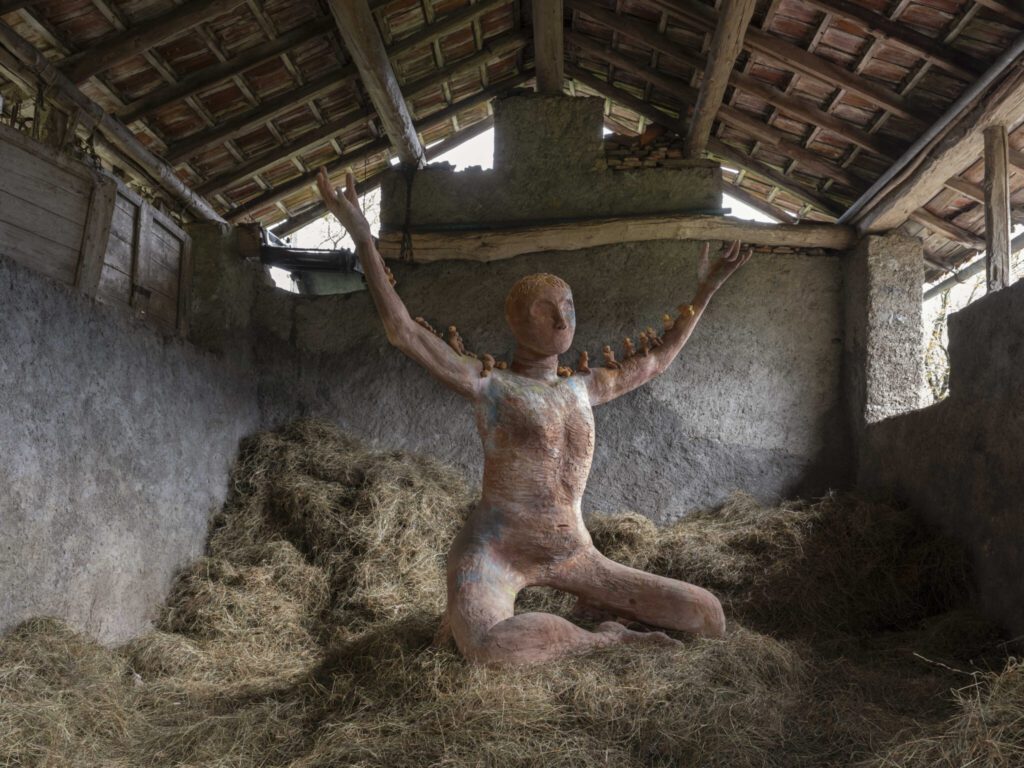
The fresh mountain air blows gently through the open sides of a barn in Sottochiesa, a small village in the Val Taleggio, near Bergamo in northern Italy. An oversized female figure sits calmly in the soft hay, her arms outstretched, in a pose that is somewhere between an embrace and exhaustion. The artist Gaia Fugazza has placed further small figures – resembling children or young shoots – upon the sculpture, which is made of reddish clay. In the title “Mother of Millions”, Fugazza refers to the plant species Kalanchoe daigremontiana, which reproduces asexually – a non-binary organism that becomes a symbol of motherhood, care and creation. Set against the backdrop of the rural barn, the work exudes a powerful presence, offering viewers a quiet moment of reflection. The soft mooing of cows can be heard in the distance, whilst outside the blazing sun shines once more over the mountains.
The sculpture and its presentation form part of the fifth and final cycle of the Orobie Biennale. Initiated last year by curator Lorenzo Giusti for the Galleria d’Arte Moderna e Contemporanea, the programme aims to take contemporary art out of the museums and bring it into contact with the communities, landscapes and infrastructure of the surrounding mountains. The title “Thinking Like a Mountain” refers to Aldo Leopold, who is regarded as one of the founders of the conservation movement.
However, the Biennale does not pander to a crude romanticisation of nature; rather, it views the mountain landscapes as a resonant space that facilitates reflection and discussion on the Anthropocene and explores the interconnections between nature, art and society. For the cycles, artists were invited to engage with issues of sustainability and community. Central to this is opening up the museum and involving the public, particularly local communities. This is because, in addition to climate change, the region is also affected by demographic shifts in the form of an ageing population.
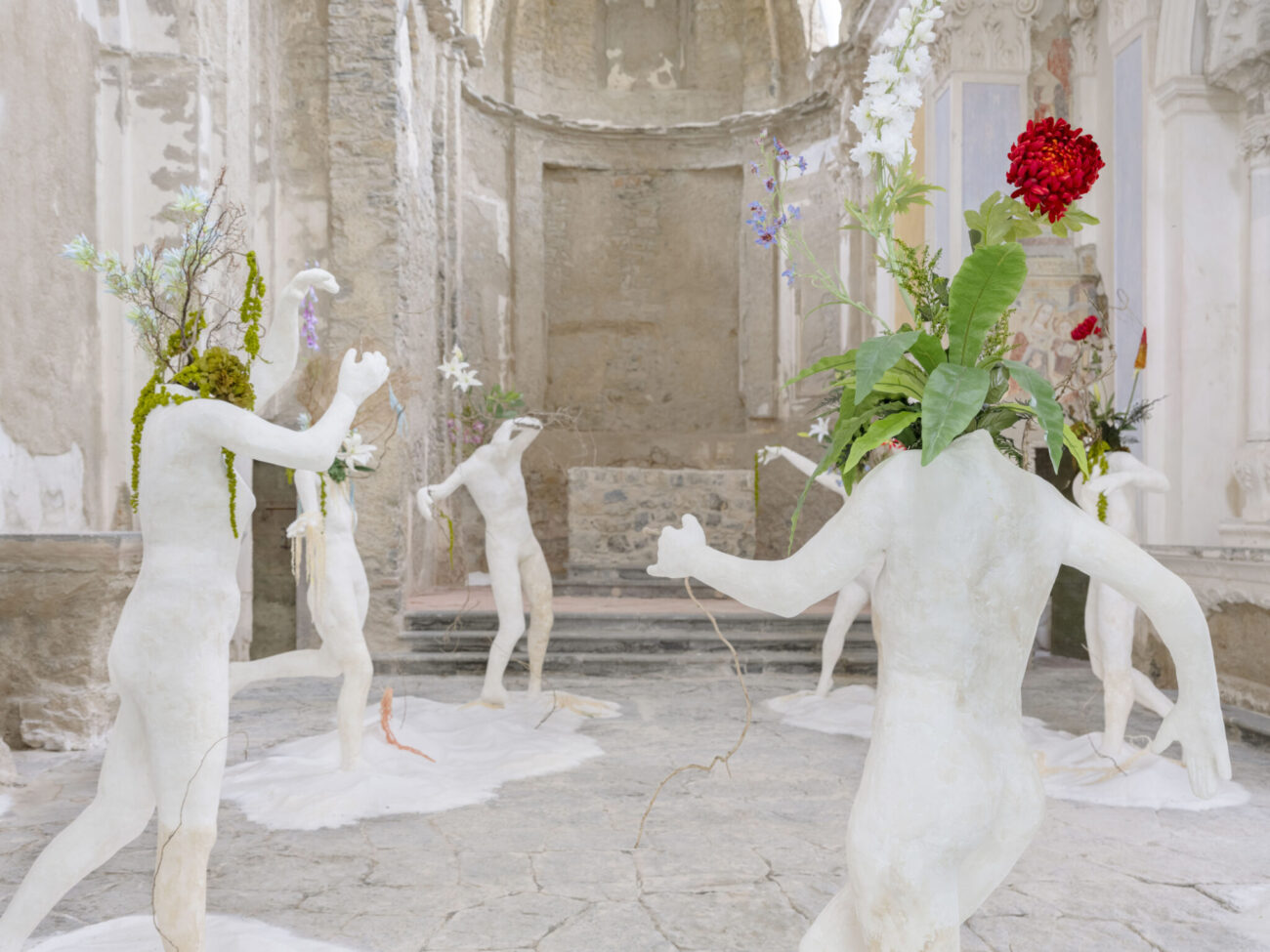
The fact that the involvement of local residents is more than just a claim became clear at the opening of Bianca Bondi’s site-specific installation in the deconsecrated church of Santa Maria di Gerosa. It felt as though the entire village, from the children to the dignitaries, had come together to celebrate over local cheese and wine; some of them had even helped create the artwork themselves. In the centre of the nave, the South African-Italian artist Bondi has placed a sculptural ensemble comprising seven life-size figures, moulded in plaster from the bodies of local volunteers. The figures have no faces; instead, bouquets of flowers, corals and crystallised organic matter appear to grow from their necks. Arranged in a circle, they possess a choreographed dynamism that reflects the sacred character of the building.
The German artist Julius von Bismarck has chosen a different approach to the existing space, realising one of his ‘Landscape Paintings’ in a mine in the old mining district of the Brembana Valley. He employs a trick from illusionist painting, reversing the pictorial perspective on the mine’s walls. Rather than simulating three-dimensionality, he uses geometric lines to dissolve the real volume and transform it into a flat surface. The location, already unreal and inhospitable in itself, thus loses its contours and becomes completely blurred.
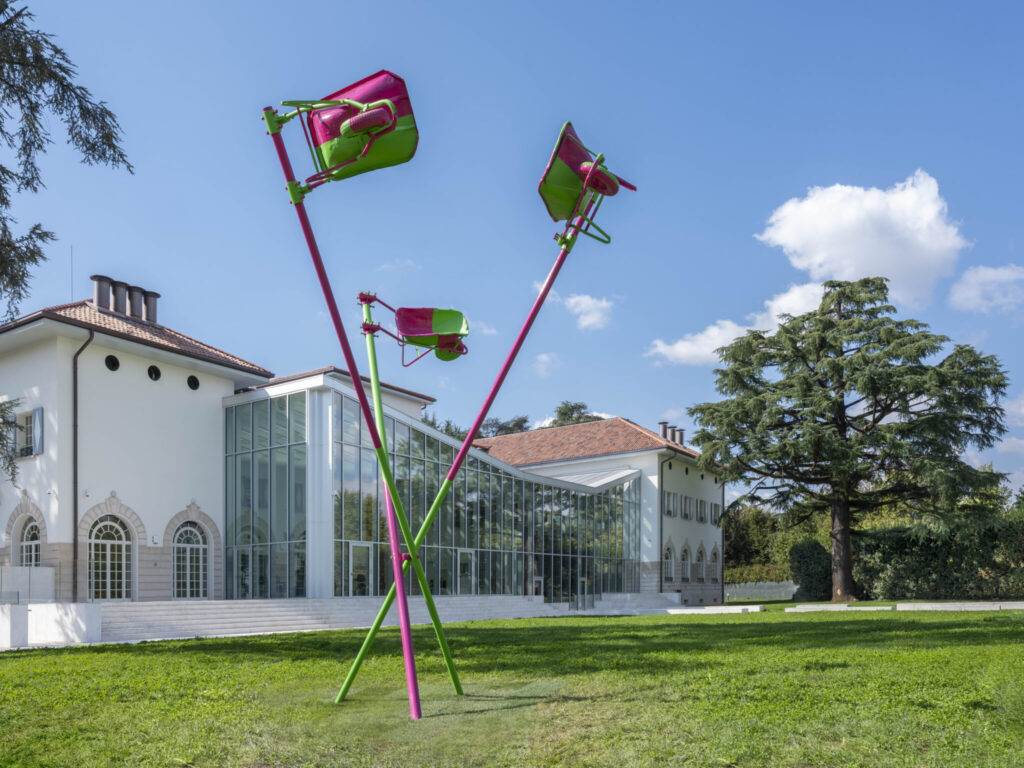
In addition to these projects, other locations in the region are also being featured. In Dalmine, Abraham Cruzvillegas has created a social and participatory sculpture from waste materials and everyday objects, which was brought to life with a performance at the opening. The artist Agnese Galiottos has created a mural on a house wall in Almenno San Bartolomeo, depicting the flight of migratory birds over Mount Albenza. In her artistic and participatory project, Asunción Molinos Gordos, in collaboration with the Botanical Garden, explores the history and stories of plant seeds. A painting by Pedro Vaz, inspired by the mountain landscape of the Alta Via delle Orobie Bergamasche, is also on display in Bergamo.
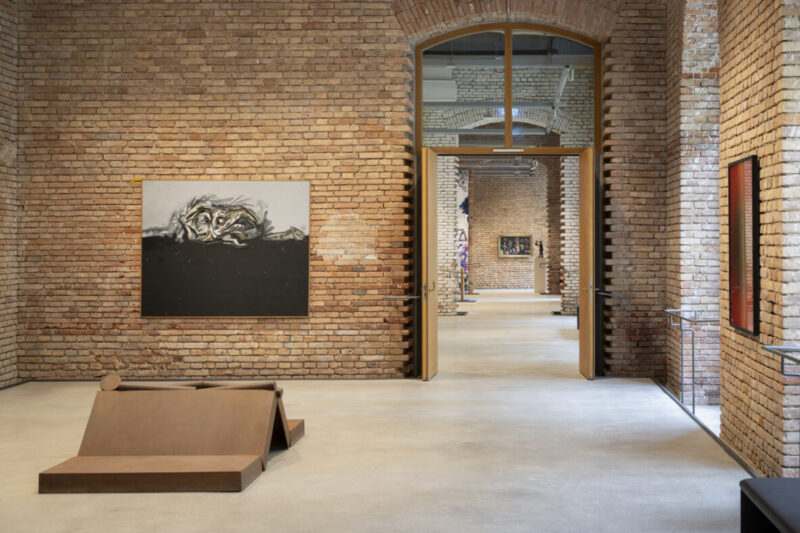
Within the GAMeC Museum itself, two exhibitions are on display as part of the Biennale. The collective Atelier dell’Errore, which emerged from work with neurodivergent young people, was originally founded in 2002 by the Bergamo-born artist Luca Santiago Mora. It has developed into a group dedicated professionally to art and performance practice. On display are wild-looking images and interventions in the architecture, both characterised by expressive colours and materials, dynamic and poetic.
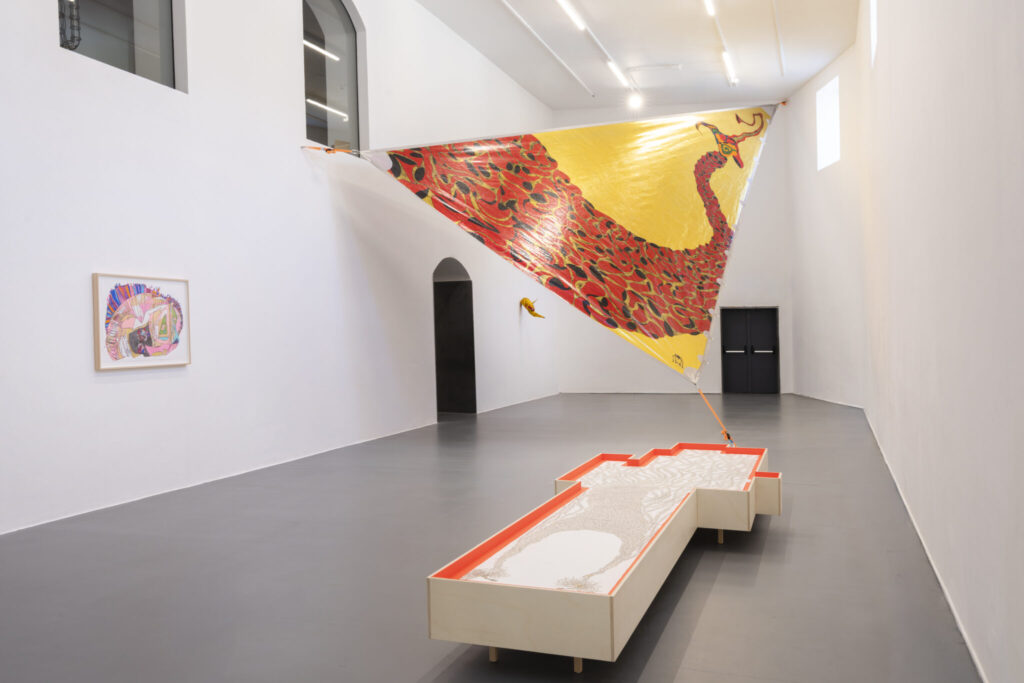
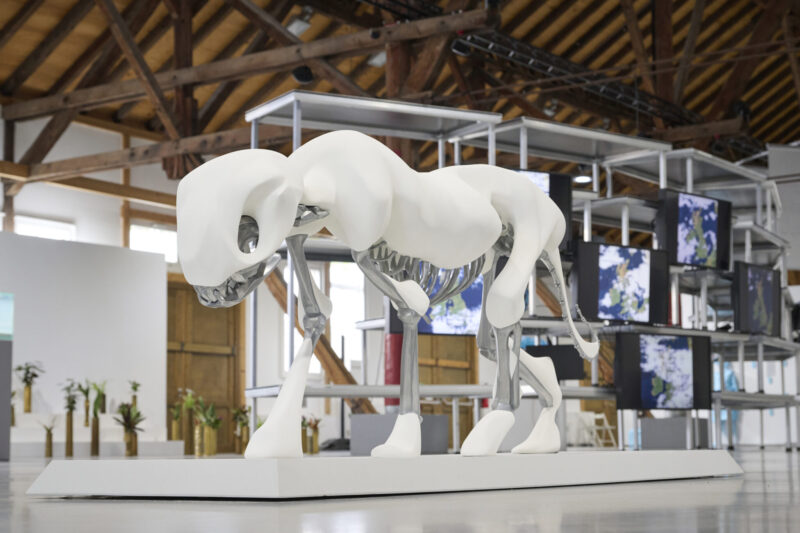
The museum also features works by Maurizio Cattelan. In keeping with the Biennale’s concept, his exhibition “Seasons” is not confined to the museum either; the artist, who was born in northern Italy, has installed works at various locations around the city. A lifelike figure of a child, which he has placed on the shoulders of a stately bronze sculpture, has already prompted several calls to the fire brigade.
The Orobie Biennale’s exhibition project brings together international and local artists with the local community. The focus here is on context-conscious art production that opens up the museum and establishes a relationship between the art, the artists and their surroundings. It also centres on a reflection on the role of the museum as an institution for the dissemination of art.
With ‘Thinking Like a Mountain’, curator Giusti and GAMeC have devised an exhibition model that relies less on institutional representation; instead, the entire region becomes a space for discourse in which processes of exchange can take place. As was the case with the last Biennale Gherdëina, for which Giusti was responsible, nature and the cultural landscape are not merely a stage for art; rather, they become integral parts of the art on display. In Bergamo, the institution is not just a host, but an active part of a diverse ecosystem. Whether and to what extent this will have a lasting impact on the discourse in the region remains to be seen.
GAMeC – Galleria d’Arte Moderna e Contemporanea di Bergamo, Via San Tomaso 53, 24121 Bergamo, IT