How do images construct and project power? The exhibition “Bild und Macht” at the Zeppelin Museum in Friedrichshafen shows how airship photography oscillates between enthusiasm for technology, propaganda and fiction. Through three contemporary perspectives, the exhibition draws a direct link to our present day, in the age of AI and fake news.
An illuminated honeycomb structure welcomes visitors to the ‘Bild und Macht’ exhibition at the Zeppelin Museum in Friedrichshafen. The design of this elegant, angular exhibition architecture refers directly to the main theme of the exhibition: the Zeppelin. At its heart are around 500 photographs from the museum’s own archive, which comprises more than 11,000 images dating from 1900 to 1940. However, the exhibition is not merely a survey of the collection; rather, it explores a complex of themes that is significant both historically and in the present day: the photographic construction and staging of technology, power and ideology. The airship, deeply rooted in the collective consciousness, has always served as a canvas for projection and has been used to stage displays of national strength and supposed technical superiority.
An imposing Zeppelin against the New York skyline, hovering over exotic South America or soaring dynamically through Berlin. The photographic images on display are not presented here as documentary evidence; rather, they form part of a constructed narrative that conveys political messages through the power of the image and image manipulation. For even in the early days of photography, images were falsified, for example, by glass negatives that had been painted over retrospectively or through photomontages. Three contemporary perspectives expand the discourse on the impact, the fragile authenticity and the contextualisation of photographic images, including in relation to generative artificial intelligence.
The interactive installation ‘Auto-Promo’ by the collective Ebb.global & Neïl Beloufa also utilises this kind of artificial intelligence. Their work uses AI as a tool to visually exaggerate and satirically question mechanisms of power. A tool, fed with historical images of Zeppelins and expanded with pop-culture motifs, generates customisable postcards for paying visitors. The exhibition makes it clear that the AI also reproduces earlier patterns of propaganda in the process. This playful, at times grotesque engagement with historical material leads directly to current questions regarding the boundaries between fact and fiction, documentation and disinformation.

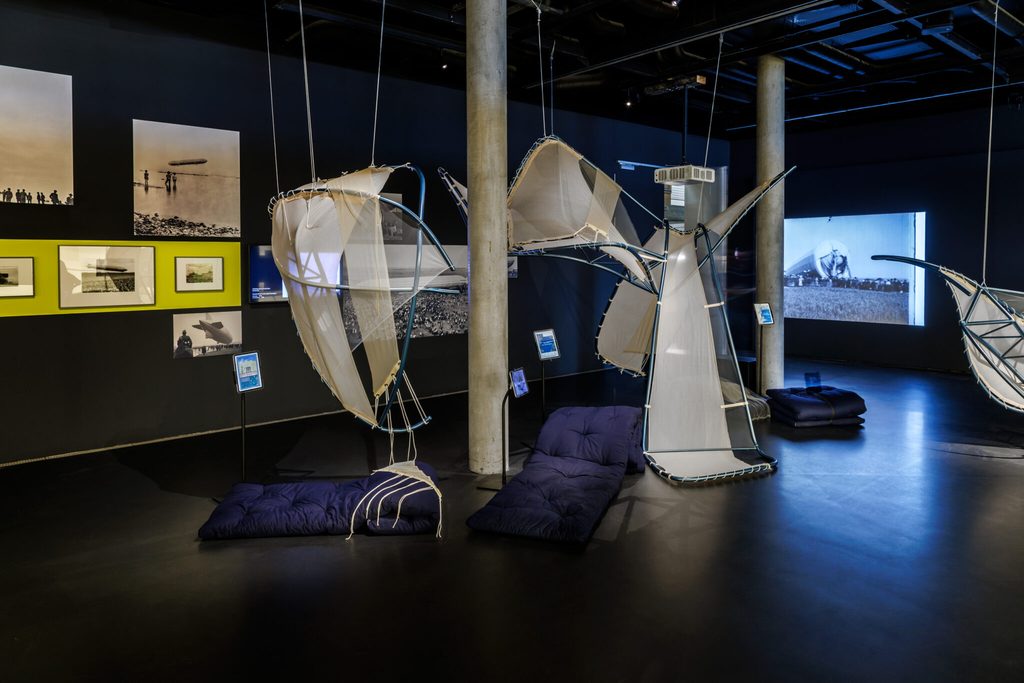
The interdisciplinary artist Aziza Kadyri, for her part, interprets the airship as a poetic, fairy-tale-like entity, inspired in part by stories from her homeland, Uzbekistan. Her installation also addresses the invisibility of women in the history of Zeppelin construction and uses historical images of seamstresses as a starting point for an individual, speculative account of history. Tablets invite visitors to generate their own narrative visual worlds with the aid of AI. Through the use of artificial intelligence, she breaks away from the Western perspective and questions the interpretation of the Zeppelin as a symbol of power, masculinity and faith in progress.
Zeppelin Museum Friedrichshafen, Seestraße 22, 88045 Friedrichshafen