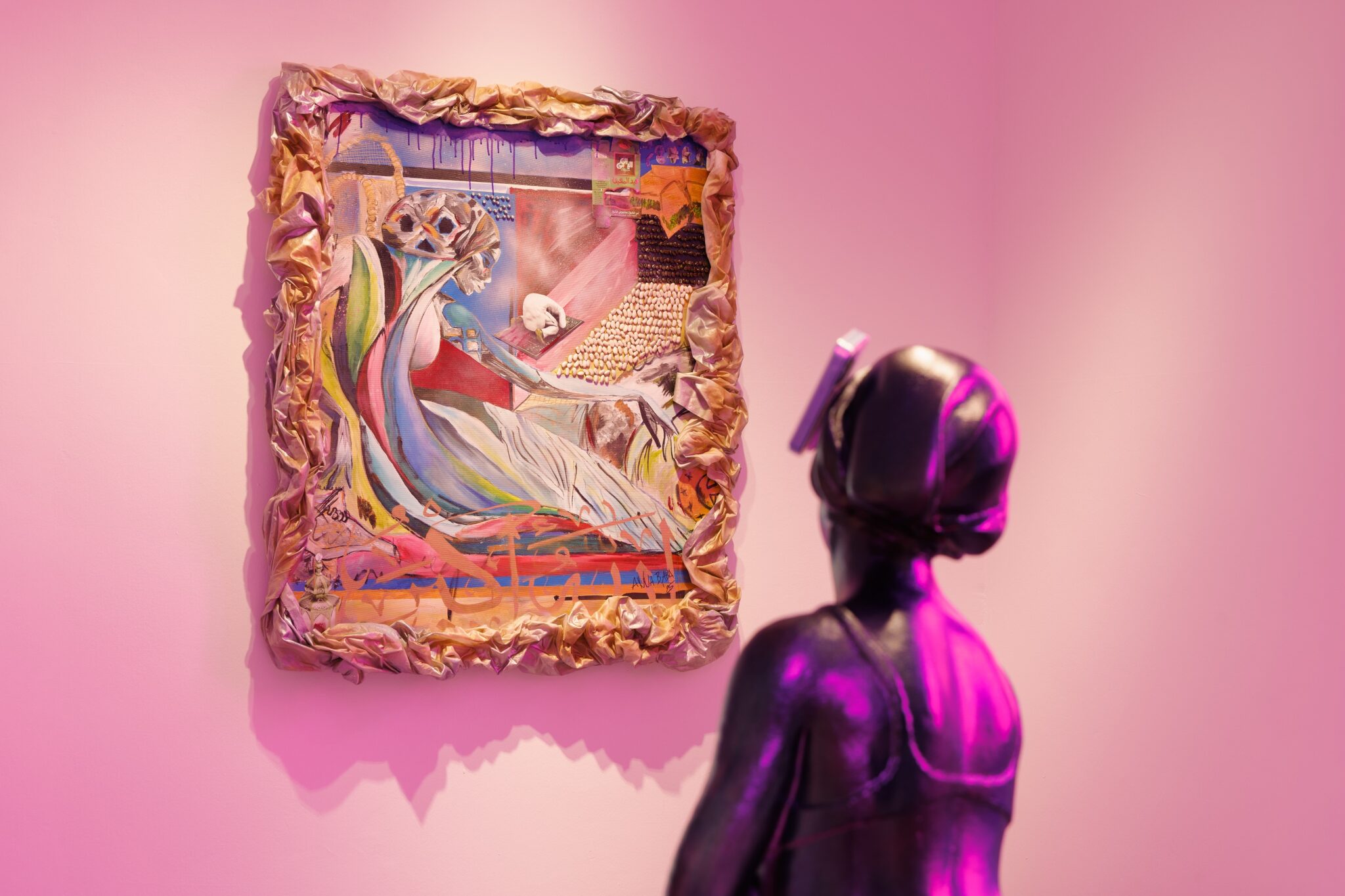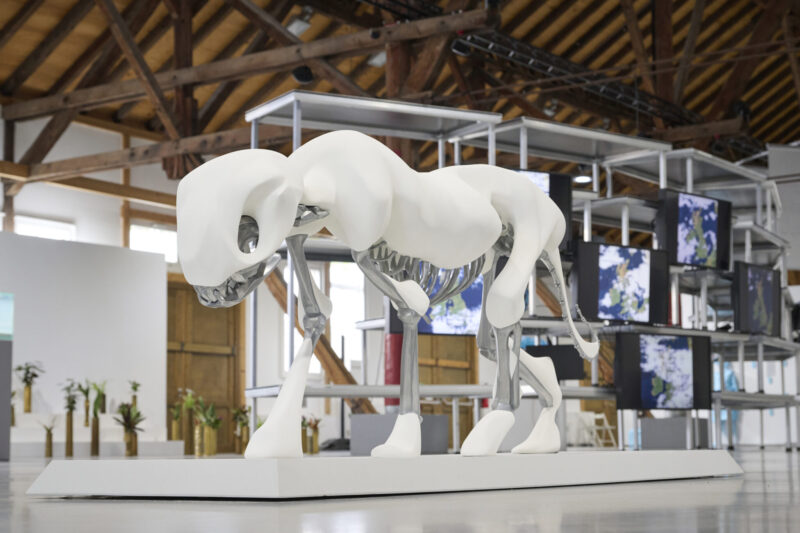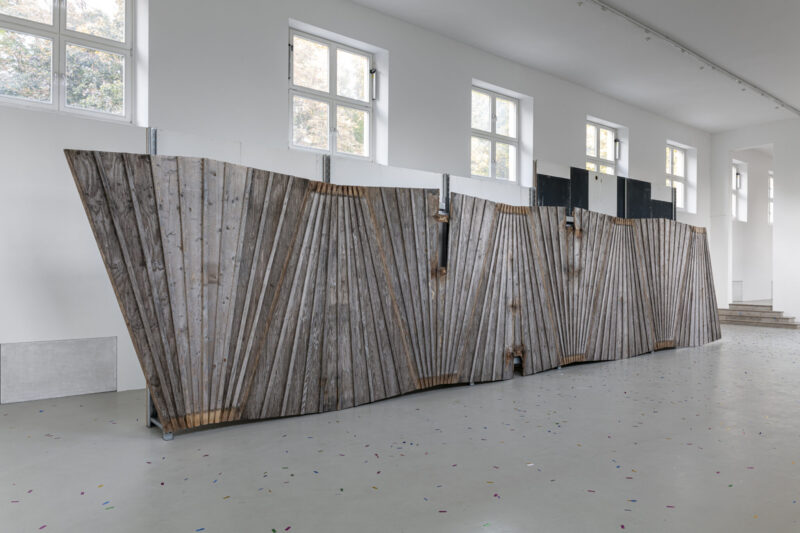
The Biennale Gherdëina 10 – (Future) Paradise Gardens in South Tyrol’s Val Gardena explores the complex relationship between nature, technology, and political responsibility in the context of the global climate crisis. Set against a backdrop of abstract rock formations and a tourist-oriented Alpine landscape, the exhibition does not present an idealized return to a long-gone natural state. In the Anthropocene, we must confront new questions that go beyond the mere domination of nature. While art cannot solve the growing ecological problems, it can highlight moments of melancholy and failure and perhaps hint at possible scenarios for coexistence in a state of permanent transformation.
The Alps are a place full of contradictions. They attract people who want to experience nature, yet at the same time they are heavily developed for tourism. In the summer, visitors come from the south to escape the heat of the cities and enjoy the cool mountain air. But climate change is already having a significant impact in the Alps: peaks are crumbling, mountain huts are facing water shortages, and debris avalanches threaten the valleys. The Alps are a prime example of how climate change is playing out in real time.
The tenth edition of the Biennale Gherdëina, a regional and international biennial for contemporary art in the Dolomites, navigates these ambivalences. Under the title “(Future) Paradise Gardens,” the focus is on exploring ecology, community, and imagination. This summer, numerous locations throughout South Tyrol’s Val Gardena will be transformed into exhibition spaces for 24 projects by 28 local and international artists. The Biennale spans three central locations: the town centers of Ortisei and Santa Cristina, as well as the Pilat Farm. The Dolomite landscape not only serves as a spectacular backdrop but is also actively integrated into the artworks. Many projects respond sensitively to the valley’s local histories, materials, and social structures.
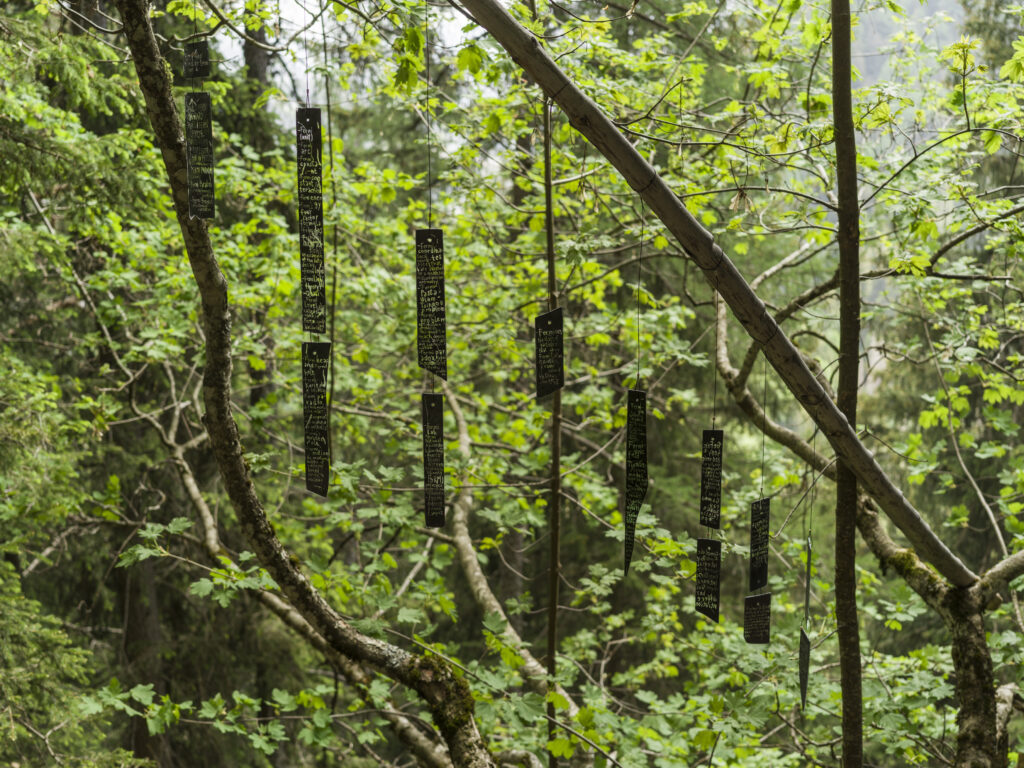
High above the village of St. Ulrich im Tal, at the tree line, lie the pastures of the Maso Pilat mountain farm. Behind the farm, in the middle of a forest, stands a poetic, ambivalent, and minimally invasive installation. Along a forest path—at first inconspicuous and easy to overlook—fragile glass elements are attached to trees and shrubs. On these panels, fragments of text can be made out, which, in Judith Neunhäuserser’s work “Mushroom Clouds over our Garden,” gradually reveal a web of fragmented narratives, historical references, and political allusions. The starting point is a historically documented stay by Laura and Enrico Fermi in the Val Gardena. Fermi, a scientist who played a key role in the development of nuclear energy and the atomic bomb, is linked in Neunhäuserser’s work to subjective memory, thus creating a landscape in which the global impacts of science and personal experiences are interwoven. The Chernobyl nuclear disaster, also a product of Fermi’s research, continues to affect South Tyrol to this day. Local mushrooms and game may exhibit elevated, though mostly tolerable, levels of radioactivity. Everything is connected to everything else. As one leaves the forest, the glass text panels tinkle in the gentle breeze.
This edition of the Biennale Gherdëina interprets the concept of the garden as more than just idyllic nature or a mere illustration of criticism. It views the garden as a site of tension between the untamed power of nature and human-shaped culture. Curated by Samuel Leuenberger, the garden serves as a contested space, a projection surface for cultural order, and a mirror of the political and ecological crises that are becoming increasingly evident in the Anthropocene. The Alps, in particular the Dolomites, a UNESCO World Heritage Site, continue to be regarded as a landscape of longing for a supposedly intact natural environment. Yet it is precisely here that it becomes clear just how profoundly the landscape has already been shaped by climate change, the transformative impact of tourism, and economic dynamics.
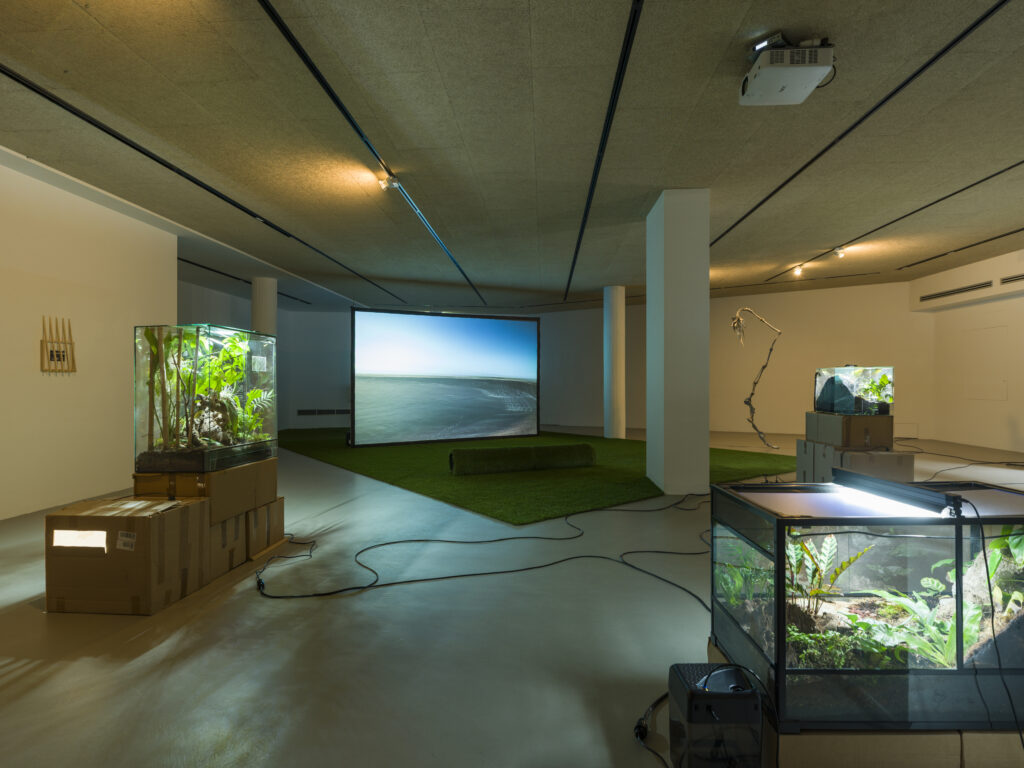
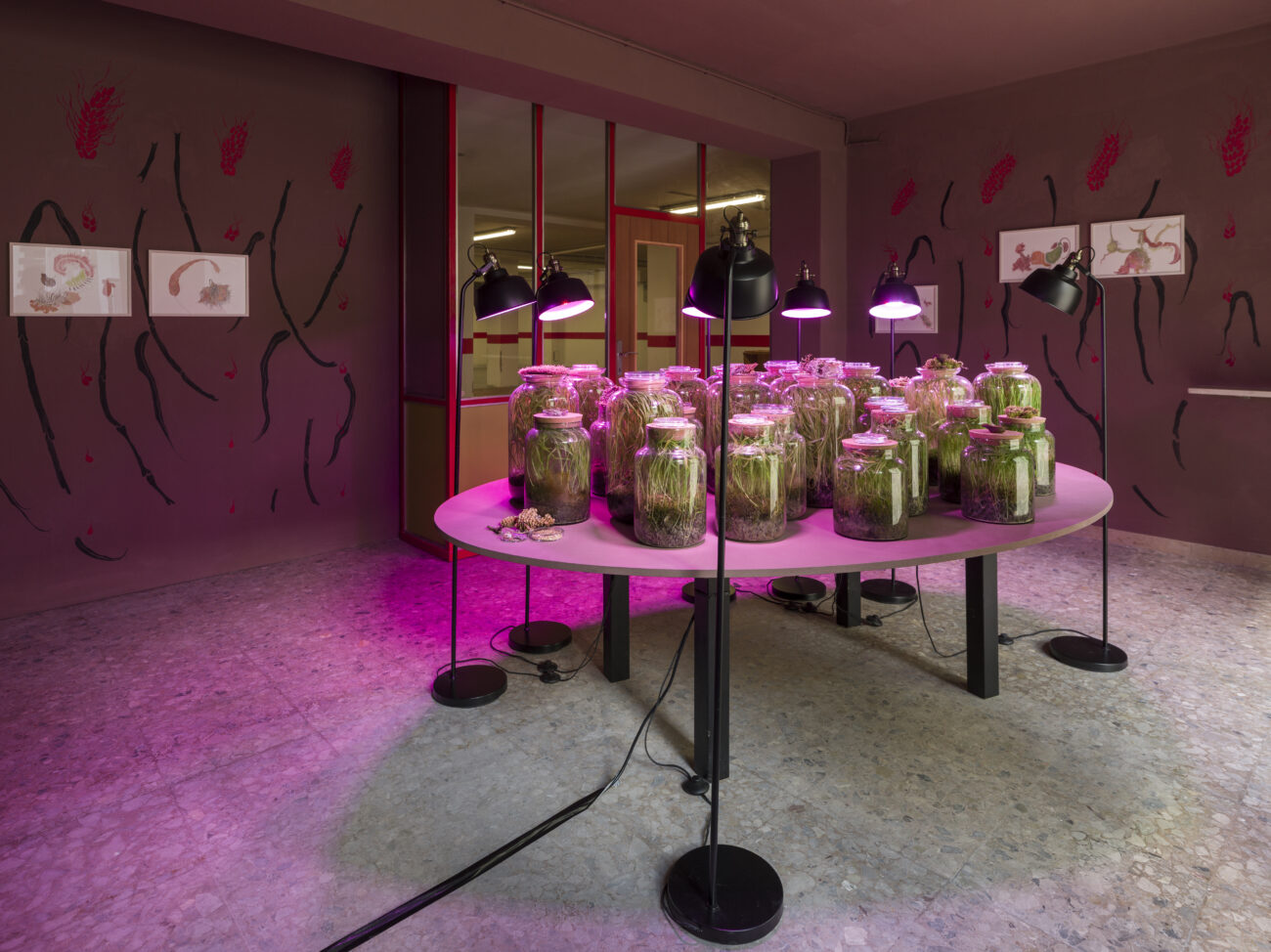
Leonardo Bürgi Tenorios’ “homescapes,” on display at the Sala Trenker in Ortisei, are reminiscent of small, artificial gardens. Using adapted terrariums, he has created a series of microenvironments that appear both intimate and artificial. These closed systems evoke hybrid scientific experimental setups and decorative home objects. Through the integration of found objects, photographs, and plant elements, fragile parallel worlds emerge that straddle the line between the image of nature and illusion. The terrariums point to a world in which nature can only be experienced within controlled, technologically regulated spaces—framed and preserved.
Right next to it, Yuyan Wang’s video installation “Green Grey Black Brown” both impresses and unsettles. Using aggressive visual language, she edits found footage of industrial agricultural production processes into a dystopian, associative sequence. Liquids, surfaces, and synthetic textures merge into a ceaseless stream of visual stimuli. The artificial turf on which the audience sits merely illustrates the idea of simulated nature. The slowed-down soundtrack of the song “Owner of a Lonely Heart”—sluggish and worn down by monotonous repetition—reinforces the impression of an overwhelming melancholy. One leaves the exhibition space with the unsettling fear that our gardens may already be irretrievably contaminated.
Alice Bucknell’s film “Ground Truthing” explores the complex relationship between nature and technology. The digital film weaves together virtual landscapes, satellite data, and ecological projections into a speculative, immersive cinematic journey. Divided into several chapters, it examines the tension between digital modeling and evidence-based knowledge. The term “ground truthing” refers to the verification of satellite data through physical experience on site. The high-tech film is being shown in a temporary venue in St. Ulrich. Viewers sit in a darkened room on seating made from local tree trunks, which evoke the organic world of nature.
During the COVID-19 pandemic, when many aspects of public life came to a standstill and nature was able to recover, the urgency of climate change suddenly took center stage in the public eye. Yet just a few years later, there is hardly any trace of that urgency left. People have returned to their old habits, air travel has increased again, and even the hype surrounding vegan diets seems to have subsided. Only the climate reports remain constant: Researchers warn of massive temperature changes and predict further escalations. Leuenberger’s curatorial approach responds to this tension with an open structure. The Biennale does not follow a linear line of argument but is organized around thematic fields such as “Commoning,” “Violent Garden,” “Queer Ecology,” and “Gardens as Spaces for Reflection and Poetry.” These chapters are not rigid but loosely connect different artistic positions. Under these conditions, the guiding idea of the garden is intended to serve not so much as a romantic retreat but as a model for how life can be organized under new and unstable conditions and what role art can play in this context.
In his work, Jacopo Belloni preserves elements of nature while simultaneously transforming them into a different state of matter. An intense, fresh, minty, and sweet scent greets visitors in the attic of an old school building in the village of St. Christina. Here, Belloni presents two groups of works. The first, “The Sleepers,” consists of milky glass forms containing seeds from the Val Gardena valley. These seeds were collected in collaboration with local communities. The aesthetic and fragile vessels are reminiscent of everyday objects such as bags, backpacks, or wallets, and thus transform into time capsules that preserve the seeds’ genetic information for an uncertain future. Here, too, an archive of endangered nature is created. The attic, however, is dominated by historic-looking copper machines connected by hoses. These distillation devices slowly extract soothing essences from various Alpine plants, releasing fragrant droplets into the room. They quietly and slowly compress the essence of nature into a consumable extract.
The discussion centers on the question of which forms of coexistence are viable in the long term and sustainable under conditions of increasing ecological instability. Ecology should not be understood here as a moral or political category, but rather as a system of relationships characterized equally by fragility, conflict, and cooperation. The positions presented do not serve to didactically illustrate political theses, but rather create moments of contemplation and provocation. While art cannot solve the growing ecological problems, it can highlight moments of melancholy and failure and perhaps hint at possible scenarios for coexistence in a state of permanent transformation.
In the central square of St. Christina, Ana Prvački has dedicated a monument—which comes across as half ironic, half deadly serious—to one of nature’s most important processes and its protagonists. The artist, who grew up in a family of beekeepers, has placed four marble sculptures in the square that are life-size replicas of beehives and resemble gravestones in shape. These “Bee Memorials,” modeled after the classic Langstroth beehive, stand as silent monuments to the honeybee—a species as essential to nature as it is threatened with extinction. Their proximity to the village cemetery creates a subtle tension between remembrance, humor, and a growing awareness of the fragility of all ecological systems.
Biennale Gherdëina, Val Gardena – Dolomites Pontives 8 39046 Ortisei (BZ) Italy.