Art between freedom, exhaustion and participation. Once again this year, the Sammlung Moderne Kunst at Herrenchiemsee Palace is presenting works by international artists in a summer exhibition. The exhibition “Könnt ihr noch?” explores fundamental democratic values such as freedom, equality and human dignity, and their relationship to art.
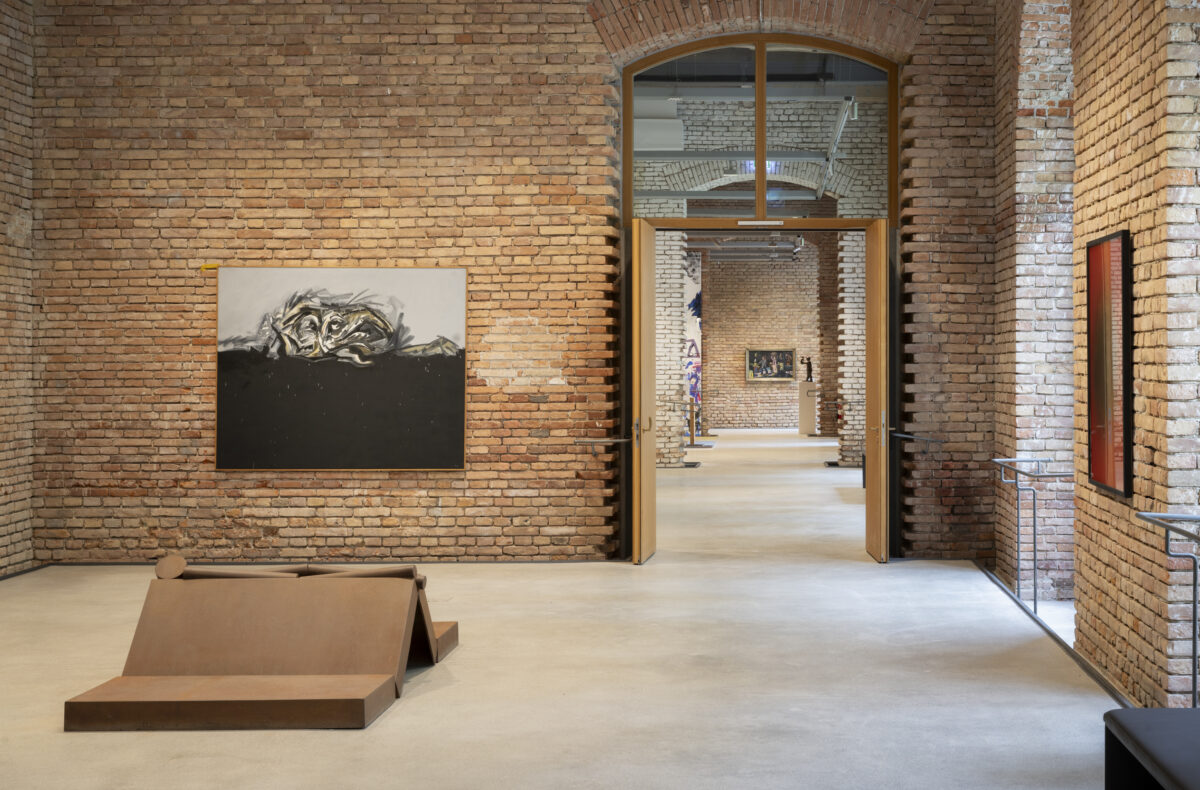
The entrance to the exhibition is somewhat tucked away on the north side of the imposing castle that King Ludwig II had built on Herreninsel in Lake Chiemsee. Surrounded by water and nature, the historicist style of the façade is particularly striking, with gold, stucco and ornamentation everywhere. Inside, however, the north wing of the castle is quite different from the rest. This part of the building, constructed at the end of the 19th century, was never fully completed. The high walls are unplastered; the red bricks and tall windows lend the rooms an almost industrial feel, like a royal loft.
In the foyer of the exhibition space, the next contrast awaits, along with the first overwhelming sensation: On an oversized screen, the video for the song “Könnt ihr noch?” by the techno-rap group Deichkind is playing. The thumping bass and staccato lyrics evoke vague feelings of exhaustion, being overwhelmed and collective burnout. Deceptive packaging, screen time – wrecking ball, reality. This marks the opening of the exhibition “Könnt ihr noch? – Kunst & Demokratie”, featuring works from the collection of Munich’s Pinakothek der Moderne. Within the context of the exhibition, fundamental questions are derived from this vague sense of being overwhelmed: how much freedom remains for democratic participation in these overwhelming times, with all their multiple crises, and what role does art play in this tension?
The tour begins and ends with Joseph Beuys, whose 1973 sculpture “Rose für direkte Demokratie” serves as a leitmotif. His approach to conceiving art as a means of shaping society is also a fundamental principle of the curatorial concept. In doing so, the curators also make direct reference to the Constitutional Convention, which took place at Herrenchiemsee in August 1948 and laid the foundations for the German Basic Law, which, following the Nazi era, also became a guarantor of freedom in the arts. For those interested, the permanent exhibition “Der Wille zu Freiheit und Demokrati” is on display in the palace.
“Könnt ihr noch?” comprises over 50 works by international artists. The works on display range from Expressionist positions of classical modernism right up to the present day. The breadth is impressive, spanning artists from Karl Schmidt-Rottluff and Ernst-Ludwig Kirchner to Henry Moore, Francis Bacon, Andy Warhol, Rosemarie Trockel and Maria Lassnig. The exhibition is divided into ten thematic sections; under titles such as “Pain and Shock” or “Creativity and Play”, the show develops its own narratives that open up a wide range of themes and questions.
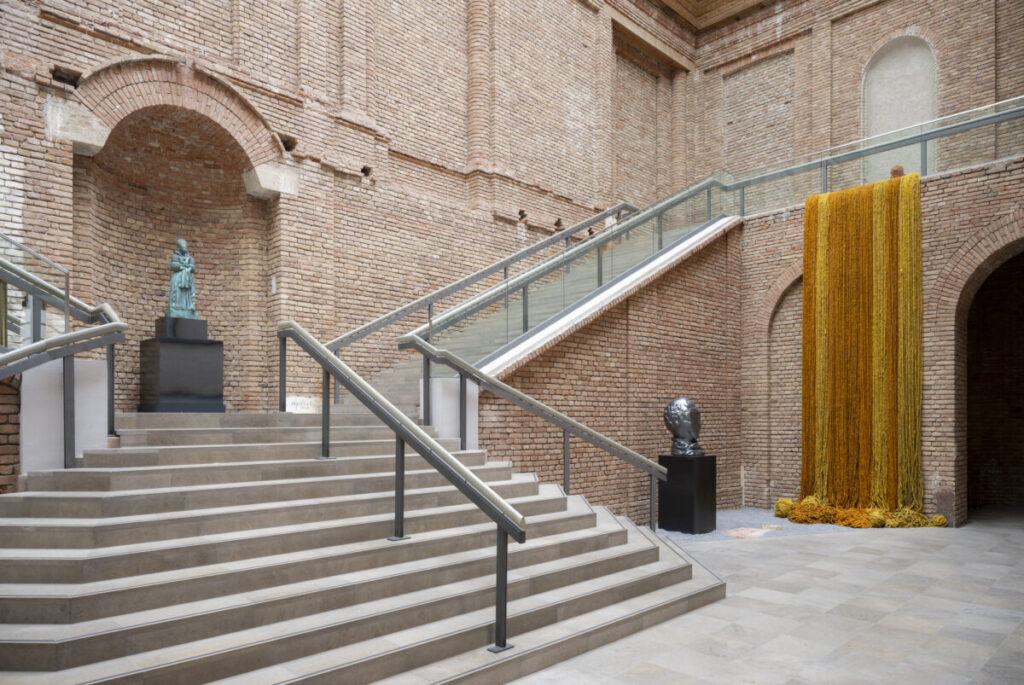
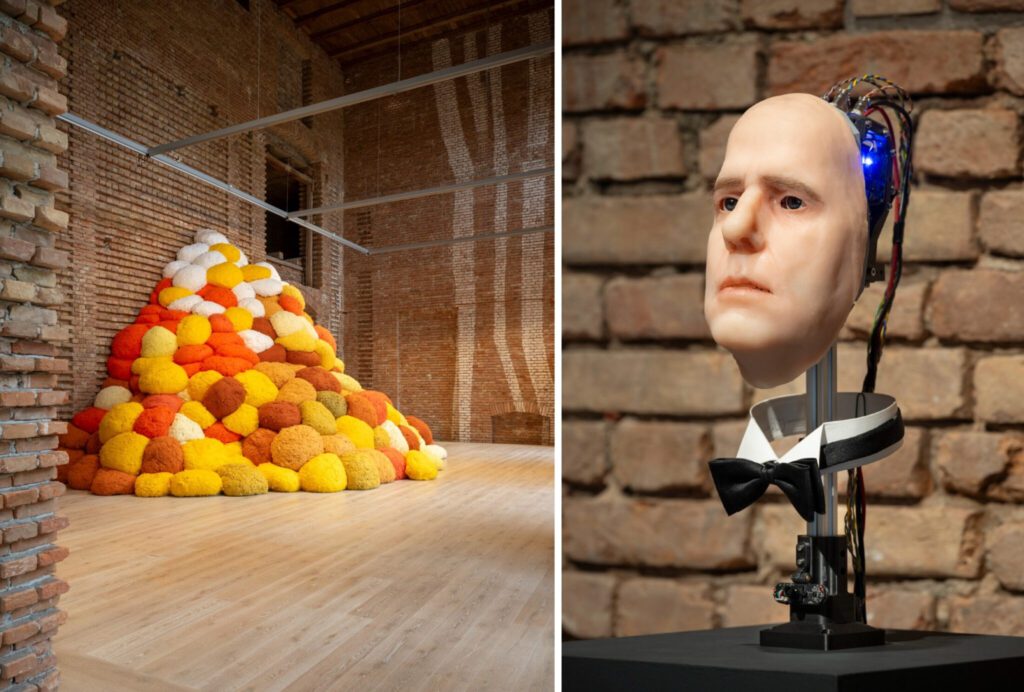
One room, for example, is dedicated to the Kinderforum van de Loo, an initiative promoting children’s creativity founded in 1970 by the Munich-based gallery owner and patron Otto van de Loo. Other rooms are devoted to feminist perspectives or suppressed social traumas. Even if one does not understand every perspective within the context of the curatorial concept, the works on display take on a special radiance in these unusual spaces. This is particularly striking in the case of Sheila Hicks, for example, who fills a room with a large-scale textile installation. Her works, which are often situated somewhere between craft and sculpture, oscillate across several levels; the large balls appear soft and taut at the same time, like individual characters within their own unique order.
The curatorial concept behind “Könnt Ihr noch?” is complex and ambitious, though it is not necessarily intuitive. Many questions are raised and various thematic areas are interwoven. Nevertheless, the result is a collection of high-quality works well worth seeing, presented in an extraordinary venue. Set against the backdrop of royal splendour and unadorned rawness, the works find a unique space in which to resonate – one that is not available in the traditional ‘white cube’. The question of what place art has in an age when we, as human beings, feel overwhelmed is answered by the works on display themselves, through their sheer abundance and diversity. For, as Friedrich Schiller once said: ‘Art is the daughter of freedom.’
Schloss Herrenchiemsee, Altes Schloß, 83209 Herrenchiemsee.